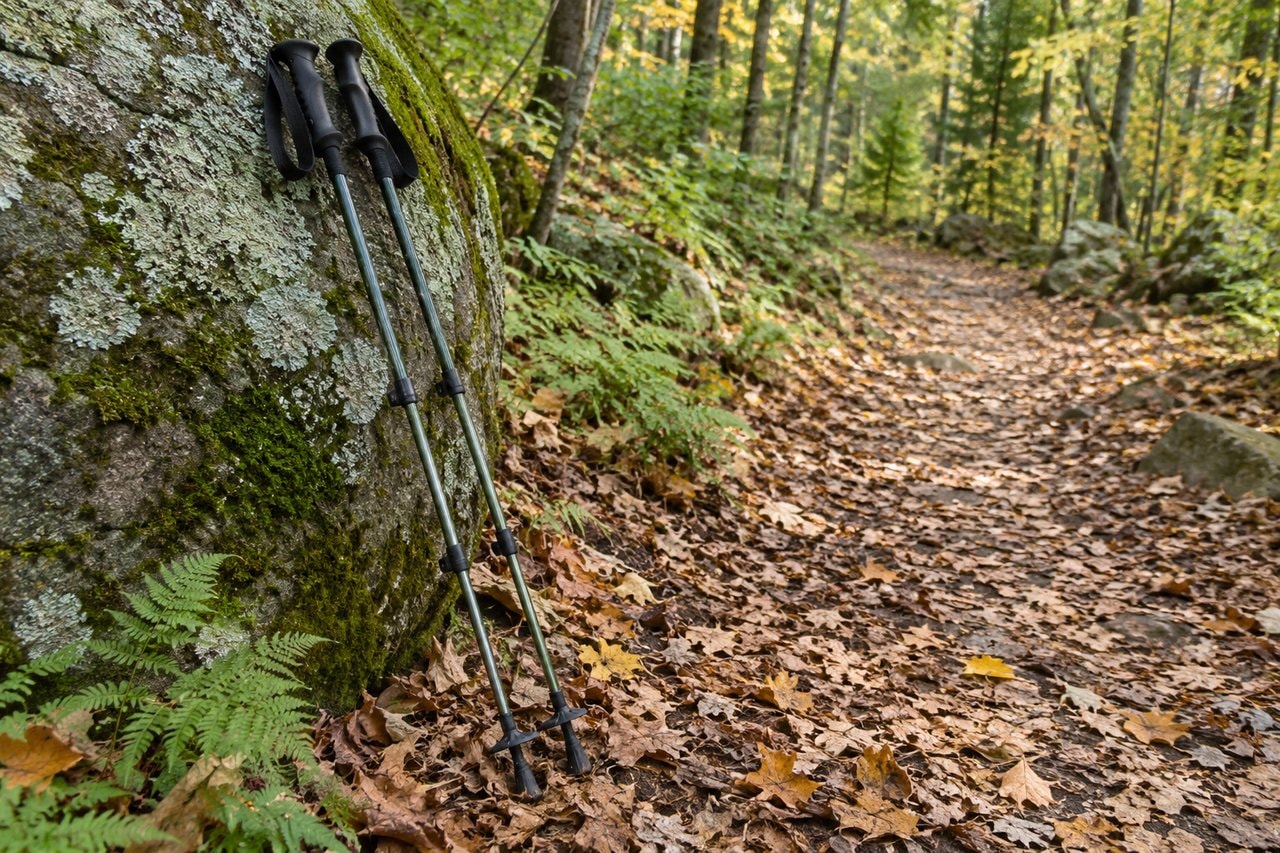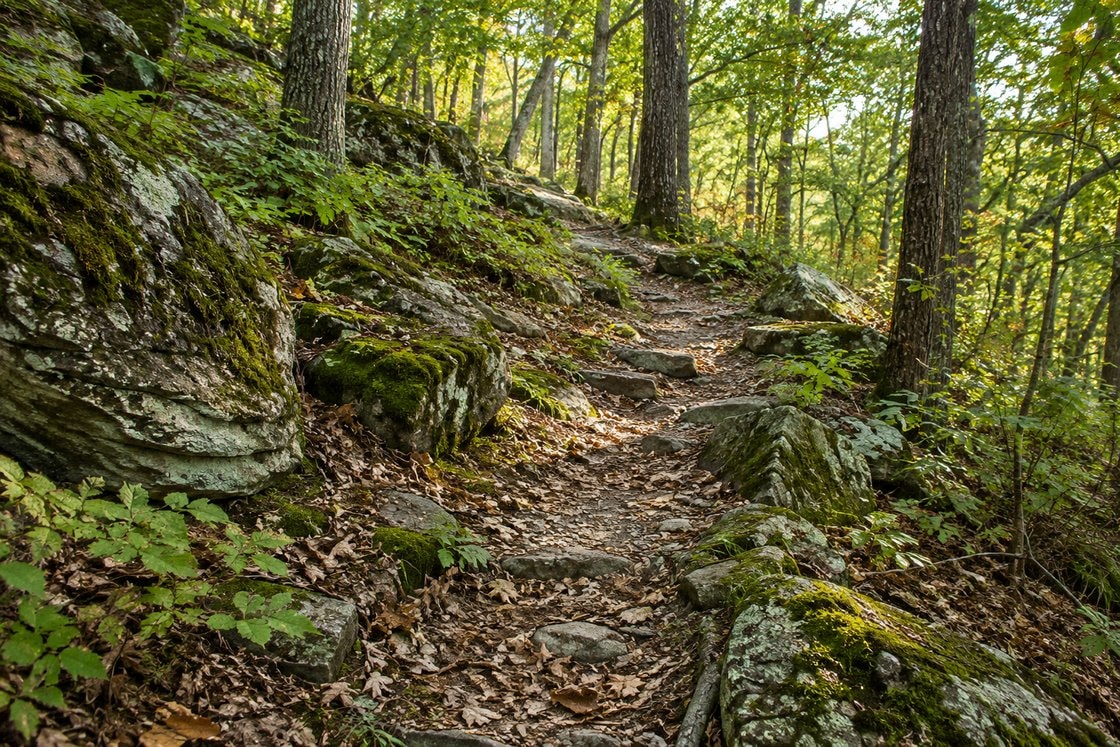
A walk in the Shawnee Hills can move from a gentle path to a rocky rise and a descent. Wikipedia's regional account describes limestone and sandstone exposed in the southern hill country; its Shawnee National Forest account places the forest within those hills in southern Illinois. Distance alone does not describe such a route. Slope, footing and what a walker carries are parts of the experience.
Wikipedia describes Fountain Bluff as rising more than 400 feet above the Mississippi River valley. A modest-looking hill on a regional map can therefore involve substantial climbing and descending. Wikipedia's hiking overview discusses terrain, weather and existing medical conditions among the factors in outdoor hazards. The research below concerns particular tasks and groups, rather than a promise about any individual walk.
this is general information, not medical advice.
Descending is a different task
Wikipedia's delayed-onset muscle soreness account describes pain and stiffness after unfamiliar or strenuous activity and associates it with eccentric contractions: muscles lengthening while working. It distinguishes this delayed soreness from discomfort during the activity and notes that soreness does not necessarily indicate the amount of muscle damage. That distinction leaves an individual symptom outside the scope of a general trail description.
In the sloped-walking study by Hu and colleagues, researchers used musculoskeletal simulations based on published data from healthy participants. They reported greater eccentric muscle work downhill than on level ground, with an increase also at the steepest uphill grade modeled. This was a simulation study in a disease-related research context, not a clinical test of hill walking for every population. Its findings concern mechanical demands within the modeled conditions.
Maeo and colleagues studied earlier downhill walking and later muscle-damage measures in untrained young men. A brief, non-damaging downhill session before a longer descent was followed by smaller changes in strength, creatine kinase and soreness than the comparison conditions; earlier level walking did not produce that result. The controlled protocol and participant group limit generalization. This is an attributed experimental finding, not a schedule for preparing a particular person's knees or muscles.
Poles and measured knee forces
Wikipedia describes trekking poles as walking accessories used for rhythm, support and stability on rough or sloping terrain. That general description is separate from what a laboratory measures. Forces, joint moments and muscle activity are related measures, but a change in one does not automatically establish a change in injury risk.
Schwameder and colleagues compared downhill walking with and without poles in a small male sample on a steep ramp. Their calculations found reductions in ground reaction force, knee moment and tibiofemoral compressive and shear forces with poles. Other measured reductions were not statistically significant because of variability. The ramp, sample and knee model define the limits of this finding; it does not establish guaranteed effects for every walker or trail.
Bohne and Abendroth-Smith examined experienced male hikers with different pack loads. They reported reduced lower-limb joint moments and reduced peak ankle and knee power absorption with poles across pack conditions. This was a controlled biomechanical comparison. It supplies evidence about the tested movements, without proving that poles prevent injuries or that a particular pack load is suitable for an individual.
Ankles, packs and uncertain predictors
MedlinePlus describes a sprain as a stretched or torn ligament, the tissue joining bones at a joint, and a strain as an injury to muscle or tendon. Its account says falling or twisting can cause a sprain and identifies ankle sprains as common. Those definitions distinguish possible injuries from the delayed muscle soreness discussed above; they do not diagnose what happened on a walk.
Hamonko and colleagues reviewed injuries during National Outdoor Leadership School hiking courses. Pack weight, body measurements and the other individual characteristics examined were not significant predictors of reportable acute injuries in their analysis. The authors called for investigation of other factors, including fitness, preparation and footwear. Failure to identify a significant predictor in that dataset is not proof that pack weight is irrelevant in every setting.
Knee problems and an activity review
MedlinePlus describes the knee as a joint involving bone, cartilage, ligaments and fluid, moved by muscles and tendons. Its account says injury or disease in those structures can affect walking. In its osteoarthritis information, MedlinePlus describes changes in joint cartilage and notes that symptoms differ among people. These general descriptions do not make pain on a descent a diagnosis of osteoarthritis.
Bell and colleagues' 2022 systematic review examined land-based exercise therapy and physical activity in people with knee osteoarthritis. The reviewers found low to moderate certainty evidence of small short-term activity increases for exercise therapy overall, without an overall medium- or long-term increase. They reported that walking and mixed programs might increase short-term activity, while resistance training alone did not show that conclusion. Some combined resistance-training and education results differed at medium follow-up. The review urged longer follow-up and activity outcomes to increase certainty. It does not prescribe hill walking or establish a durable effect.
The Office of Disease Prevention and Health Promotion describes the federal Physical Activity Guidelines for Americans as a science-based resource for professionals and policymakers. MedlinePlus's physical-fitness overview discusses aerobic, strength, balance and flexibility activities and the importance of a person's health circumstances. Those resources provide general context, rather than a personal exercise plan derived from a terrain description.
Heat, ticks and plant contact
MedlinePlus explains that hot, humid weather can overwhelm cooling by sweating. Its heat-illness account describes heat stroke as life-threatening and says to obtain medical help immediately for signs such as confusion or dizziness. Summer conditions deserve attention alongside slope; the effort measured in a walking study does not account for every outdoor circumstance.
The Illinois Department of Public Health records infected blacklegged ticks in Illinois. MedlinePlus identifies Lyme disease as a bacterial infection transmitted by an infected tick. Wikipedia's accounts distinguish the blacklegged tick, Ixodes scapularis, from the lone star tick, Amblyomma americanum. The latter is associated with other infections and a Lyme-like rash illness, rather than being interchangeable with the Lyme vector. MedlinePlus recommends checking clothing and the body for ticks after outdoor exposure.
MedlinePlus's poison ivy, oak and sumac information describes an allergic skin reaction to plant oils and notes that oil can remain on clothing, tools and other surfaces. That account concerns contact and its consequences, not a home remedy. For the wider walk, return to the natural events calendar, the agency safety information on regional snakes, and the landscape history of Fountain Bluff.