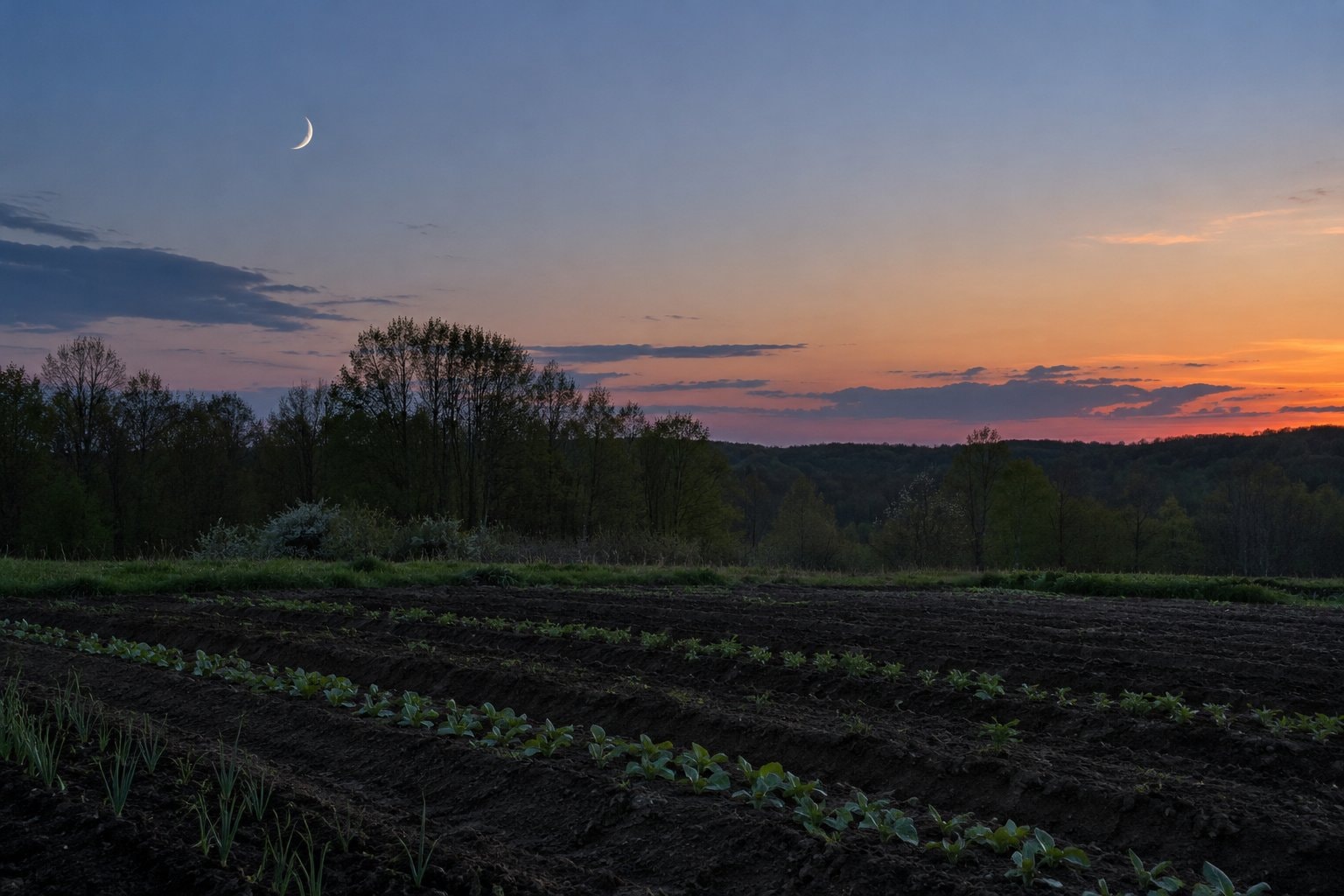
The Moon is easy to notice, easy to name and tempting to consult. A bright full disk or a thin evening crescent gives the year a visible rhythm. Gardening by the moon uses that rhythm as a proposed guide to work in the soil. The custom deserves a clear description as a tradition, followed by a separate question about what its proposed explanations and the research actually establish.
A calendar made from a changing light
University of Illinois Extension’s discussion of the Moon and the Old Farmer’s Almanac describes a familiar division: practitioners associate the growing Moon with above-ground crops and the shrinking Moon with below-ground crops. It presents these ideas as an agrarian tradition rather than scientifically demonstrated crop-production methods. That separation is useful. An account of a custom should make clear whose rule it is, instead of silently adopting the rule.
NASA’s moon-phase explanation supplies the underlying astronomy. Sunlight illuminates the Moon, and the visible portion of its sunlit side changes as it travels around Earth. Waxing and waning describe that changing appearance. The phases themselves are real astronomical observations. A claim that a particular phase improves a crop adds a different proposition, one that needs evidence about plants rather than only a correct description of the sky.
The fuller planting tradition adds the zodiac to the lunar cycle. Planting by the signs explains that system as folklore. Phase planting and sign planting are related, but they are not interchangeable names for every version of the practice. Comparing their descriptions helps show how a simple celestial rhythm can become a much more elaborate set of customary rules.
The proposed connections
The University of Washington’s Elisabeth C. Miller Library discussion of lunar gardening describes proposed links through soil moisture and light exposure. The discussion also emphasizes the lack of extensive scientific testing behind the proposed benefits. An explanation about tides can sound persuasive because tides are familiar. It still needs to show that the relevant force produces the claimed effect in the soil, the seed or the plant.
Different explanations also need to be kept apart. A seed’s response to light is not automatically evidence for a response to a calendar phase. A relation between light and germination does not, by itself, establish all the instructions in a lunar planting schedule. The library’s discussion is valuable partly because it raises these distinctions. A gardener can understand the proposed connection without taking the proposal as a settled result.
A review and its limits
University of Illinois Extension’s review of lunar influence on gardening describes an Agronomy review examining lunar gravity, moonlight and plant processes. Its account reports no consistent relationship supporting a lunar influence on plant life. The review compared proposed lunar forces with the forces involved in plant processes, rather than treating the existence of ocean tides as sufficient proof for a gardening practice.
Washington State University Extension’s discussion reports the same review’s conclusion that reliable scientific evidence did not justify agricultural practices conditioned by lunar phases. It also reports the call for further research. Those statements can coexist. A question remaining open to investigation does not mean that an existing planting rule has been validated. Further work would need to establish a relevant effect and show what the effect actually means.
The Extension accounts mention a more specific relationship involving a shrub, pollen and pollinators able to navigate in full moonlight. That example is not a general planting calendar. It concerns a particular ecological relationship. Keeping such findings at their proper scale is more interesting than forcing every effect into the same rule. Nature can have a response to night light without supplying a universal schedule for a vegetable bed.
Biodynamic calendars are another system
Wikipedia’s biodynamic-agriculture reference describes farming methods that include astrological sowing and planting calendars. It also reports the lack of scientific evidence for the distinctive esoteric claims and the absence of demonstrated beneficial differences from similar organic and integrated practices. That account concerns a broader agricultural system. A lunar calendar is one part of it, rather than evidence that every part has the same standing.
Compost, a planting calendar and a claim about celestial influence can sit together in a practice while needing different kinds of evaluation. It is possible to explain that mixture plainly. The history of a belief, the ordinary work accompanying it and the proposed cause of an outcome should not be blended into a single statement of success. Wikipedia’s wider lunar-effect reference similarly distinguishes claims about a broad lunar rule from evidence in specific organisms.
Keep the garden in the foreground
Washington State University Extension’s discussion places local soil temperature and frost dates ahead of broad calendar formulas. The gardening year considers those ordinary growing conditions separately from lunar tradition. The sky page explains the phases themselves. Read together, they allow a familiar custom to remain part of cultural history while the garden is understood through the conditions and evidence relevant to it.