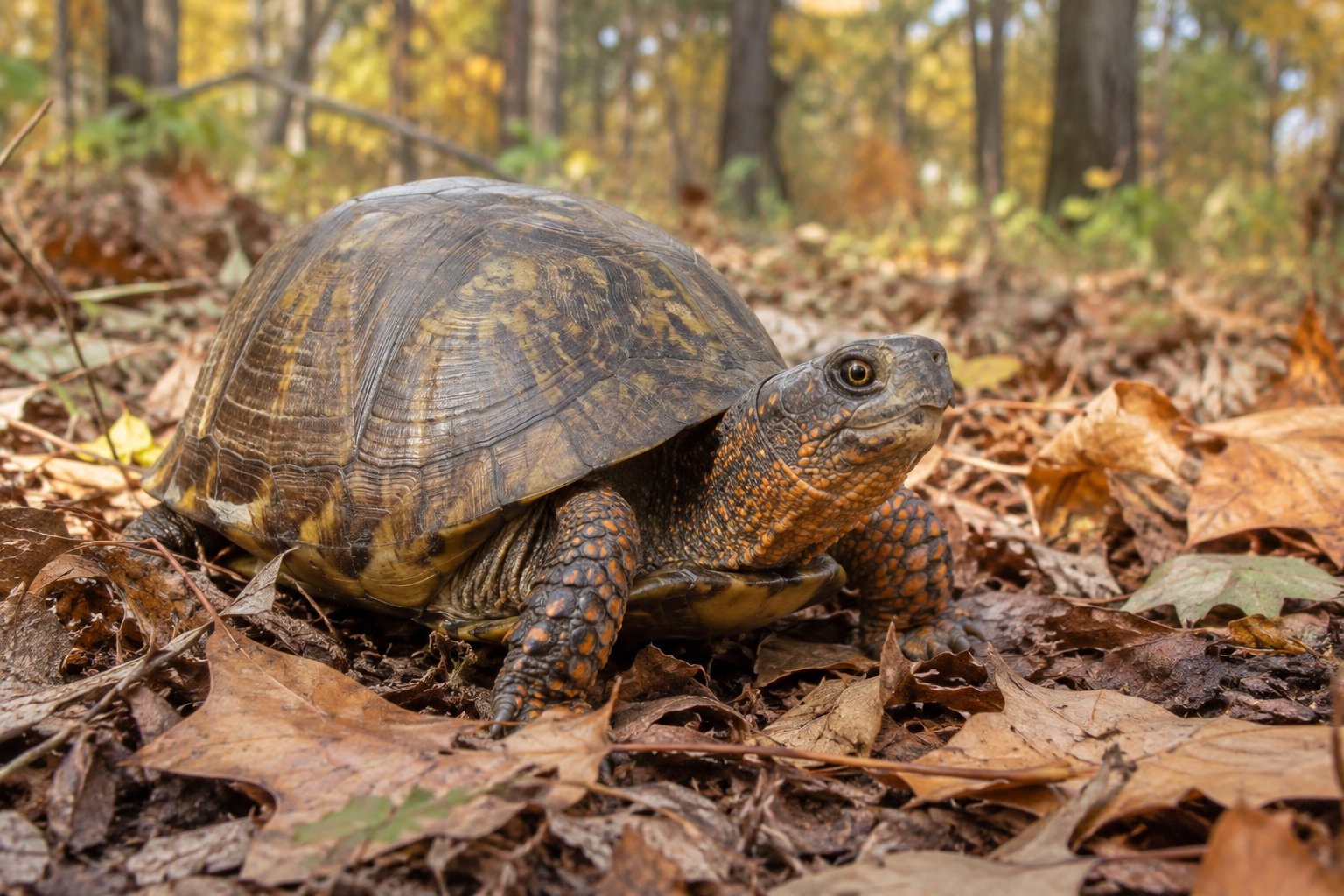
The three-toed box turtle, Terrapene triunguis, is a small land-dwelling turtle of the south-central United States. A high domed shell and a hinged lower shell make it recognizably a box turtle. It belongs especially to the woodland side of a regional walk, where leaf litter, openings and damp retreats matter more than deep water.
The Missouri Department of Conservation's guide places this turtle in Ozark woodlands and describes the use of both wooded and grassy habitat. A glimpse on an open patch does not reveal the whole home. The turtle moves among parts of its surroundings as conditions and seasons change.
The box is a moving animal
The upper shell may be olive or brownish, sometimes with faint yellow or orange markings on its large plates. A ridge often runs along its center. The lower shell can hinge upward against the upper shell, enclosing the vulnerable head and limbs. That closing structure is the source of the box turtle's familiar name.
Color on the head and front limbs may be yellow or orange, and adult males often show stronger orange coloring. Such details are visible when an animal is already in view. There is no need to lift, turn over or pry open a turtle for an identification. A turtle closing its shell has supplied a clear reason to give it space.
Neighbors along the Mississippi
Wikipedia's three-toed box turtle account notes that it can be difficult to distinguish from the eastern box turtle where their ranges meet in the Mississippi valley. The Missouri field guide similarly describes animals with blended characteristics along the state's eastern and southeastern edge. Regional turtle names do not always draw an obvious line on the ground.
The ornate box turtle is another neighbor, more strongly associated with grassland and usually more boldly marked with yellow lines. Habitat and shell pattern offer context, but an uncertain roadside or woodland view can remain uncertain. Recording a box turtle as a box turtle is more useful than handling it to force a narrower answer.
A year across woods and openings
A typical active day can include feeding, basking in an opening and resting in dense grass or dead leaves during warm weather. Toward evening the animal seeks a retreat, often in litter or shallow soil. These resting places are called forms. They are small spaces in an ordinary-looking landscape, easily missed by a passing walker.
Studies described by the Missouri field guide found seasonal use of woods and grassland, with moisture and temperature helping explain the changes. Turtles may use wooded areas near winter shelter in early spring, move into openings during milder weather, and return to woods during summer heat. A patch of grass and the trees beside it can both be part of the same turtle's habitat.
Although land is central to its life, the three-toed box turtle can soak in shallow water and can swim. During hot, dry conditions, temporary pools and pond edges may be used. In winter the animal becomes dormant in litter and soil. Removing it from a familiar place separates it from a setting that includes shelter through different seasons.
Food on the forest floor
Young turtles eat mainly earthworms and insects. Older ones take more plant material and fungi, including berries, mushrooms and tender shoots, while still eating animals such as snails and insects. The menu changes with available food. A turtle moving slowly through litter is engaged with the same woodland that produces fruit, invertebrates and fungi.
Egg laying takes place in warm months, with females choosing loose soil or sand. Some late hatchlings can remain in the nest until the following spring. Large adults are well defended, but eggs and young are food for skunks, raccoons and other predators. The shell does not make every stage equally secure.
Leave its home attached to it
The Illinois Department of Natural Resources does not endorse collecting live wildlife. Its guidance says that permits apply to some wildlife and that collecting is prohibited in state parks and nature preserves. The Illinois Administrative Code also regulates collecting and keeping native reptiles and amphibians. A wild box turtle belongs where it is found: observe it without taking it home.
The Missouri field guide identifies habitat loss, roads and collection as threats even where box turtles remain familiar. A slow pace and a closed shell do not make an animal available for possession. Leaving it in place allows its feeding, retreats, nesting and winter shelter to remain connected.
The common snapping turtle uses a very different arrangement of shell and aquatic habitat. The eggs and hatchlings page follows the vulnerable stages shared by these reptiles, while the natural events calendar places turtle activity among seasonal changes in the woods.