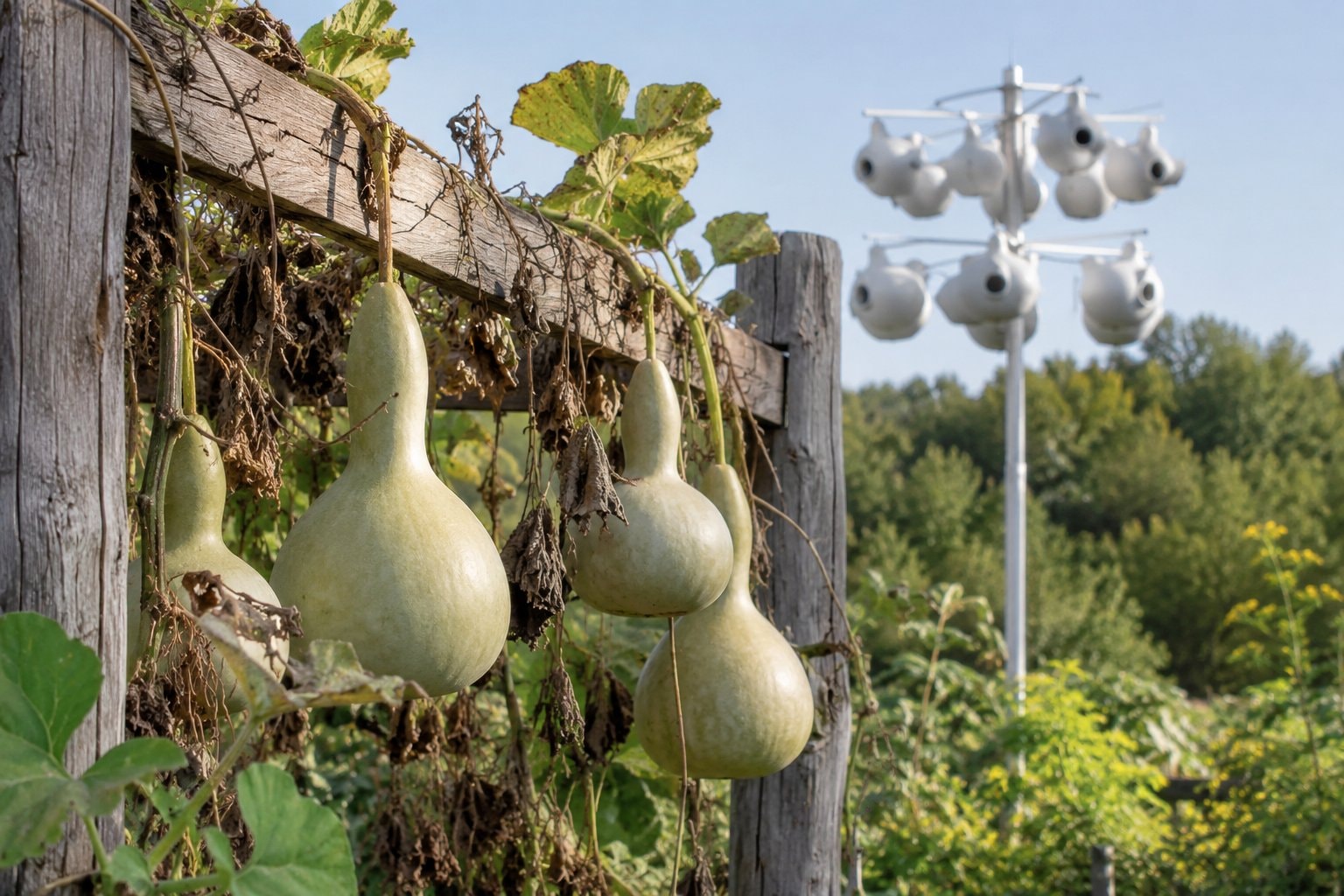
A bottle gourd is a crop with a life after its growing season. Its mature shell can become a container, a musical instrument or a birdhouse. The living vine and the dry vessel are the same plant's different stages. That is why gourds belong as comfortably in a discussion of household history as in a garden, and why a rack of hollow gourds can lead the eye upward to a colony of purple martins.
A broad word, a particular vine
Wikipedia's article on gourds explains that the word covers fruits from several plants, especially members of the genera Lagenaria and Cucurbita. It can also mean the hollow dried shell rather than the whole plant. The general name therefore does not guarantee that a decorative fruit, a bottle-shaped vessel and a luffa are the same species.
The bottle gourd, Lagenaria siceraria, is described in Wikipedia's calabash article as a vine in the cucumber family, native to tropical Africa and cultivated widely in the tropics. Fresh fruit has pale green skin and white flesh. Mature fruit can be dried for vessels and utensils. Its shapes range from rounded to narrow-necked and elongated, so a familiar bottle outline is only part of its variety.
The calabash name can also refer to an unrelated tree whose hard fruits serve similar purposes. The shared use helps explain the shared word, but not a botanical relationship. A plant name is most useful when it is paired with the species and the object being discussed. Here the subject is the bottle-gourd vine and its shell, rather than the tropical calabash tree.
A crop grown for a container
The calabash article describes the bottle gourd as an early cultivated plant valued for containers rather than primarily for food. It records pre-Columbian presence in the Americas and discusses evidence for its movement and domestication across continents. The account compares ideas about human transport with later genetic work supporting a connection between American and African gourds and possible ocean drift.
Those are research interpretations of a crop's long journey, not a simple story of a single traveler carrying the first seed. Archaeological and genetic evidence address different parts of the question. What is clear in the account is the widespread use of the mature shell. A container that grows on a vine gave people a material quite different from a clay pot or a wooden bowl.
The gourd article lists storage, utensils, musical instruments and decorative work among the uses. The calabash article describes hollow shells as bowls and liquid containers, as well as resonators and percussion instruments. Shape and hollowness make the shell useful in different ways: a narrow neck serves a vessel, while an open chamber can become part of an instrument. These are cultural uses of the crop, not instructions for turning every ornamental gourd into food.
The garden before the shell
The calabash article describes a warm, sunny growing position, plentiful moisture during growth and well-drained soil. It notes the vine's vigorous climbing habit and the need for support. Its flowers are white and open at night. The account discusses nighttime pollination as part of successful fruit formation, which gives the garden another reason to be observed after the bright part of the day.
The wider gardening year sets warmth and moisture beside frost and seasonal planning. Gardening for butterflies and moths also considers night-blooming flowers and moth visits. These links concern the living plant and its visitors; the history of the dry shell begins with that growth.
A cavity for a swallow
Wikipedia's purple martin account identifies the bird as a member of the swallow family and describes nesting in natural or artificial cavities. In eastern North America, martins are almost entirely dependent on human-provided nesting structures, including real or artificial hollow gourds. The same account contrasts that reliance with western birds using natural cavities, such as old woodpecker holes.
Martins nest in colonies, and the account describes both members of a pair inspecting possible nest sites. A hollow gourd is a cavity in that process, rather than merely a decoration near a vegetable plot. Their association with people has a long history: the article records Indigenous use of gourd houses before European colonization. It also describes competition from house sparrows and European starlings for nesting cavities.
Purple martins take insects in flight. The article qualifies the familiar mosquito-control reputation by noting that mosquitoes are not a large part of their usual diet. A nesting colony is interesting without promising a pest-free yard. For another bird living close to human ground, read living with killdeer. The gourd and the martin offer a quieter lesson: a plant can become part of an animal's habitat long after it stops being green.