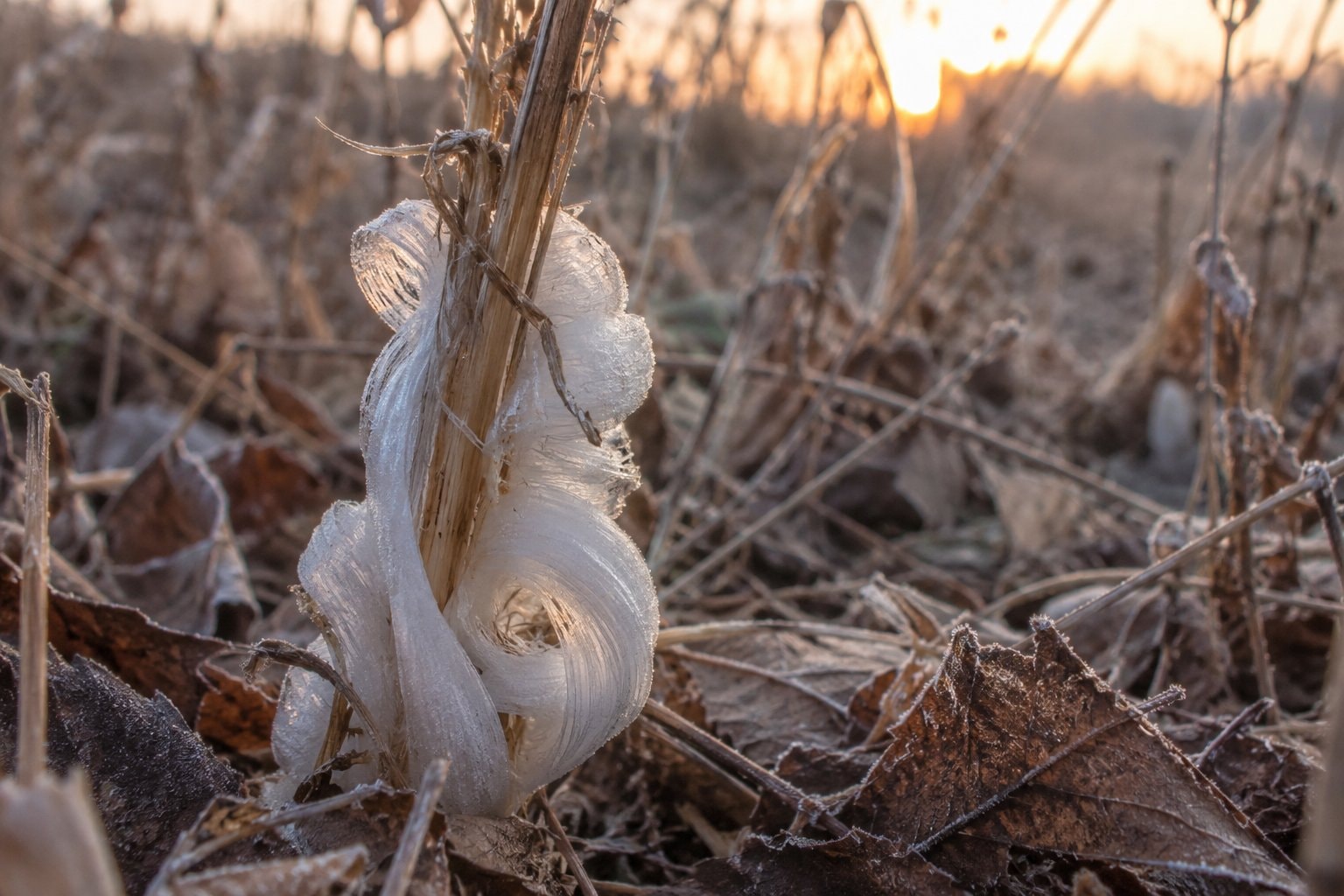
Frost flowers are ice, despite the botanical name. Thin ribbons extend from a plant stem and curl into shapes that suggest petals. The plant provides the structure through which water moves; freezing makes the pale folds. Seen close to the ground on a cold morning, they can look like a small late bloom until the connection with the stem becomes clear.
Wikipedia's frost-flower account describes this formation in autumn and early winter, when freezing weather arrives while the ground is still unfrozen. The timing depends on that combination of conditions. A cold date on a calendar is not enough by itself, and an ordinary coating of frost on leaves is a different sight.
From a crack to a ribbon
Water expands when it freezes. In the explanation given by the frost-flower account, freezing within the stem creates long narrow cracks. Water moves through these openings by capillary action and freezes when it meets cold air. Continued water movement pushes the forming ice away from the stem, making a thin sheet.
The sheet can fold and curl rather than remaining flat. What looks like a cluster of petals is therefore a record of water continuing to emerge through a narrow opening. The flower-like shape is ice taking form, not a flower held under a coat of ice. Following the ribbon back to its point of origin is the useful visual clue.
Cold air and unfrozen ground occupy different roles in the process. The cold freezes the emerging water, while the ground conditions permit water to remain available. The formation belongs to a temporary meeting of those circumstances, not to the coldest part of winter simply because it is colder.
The plant is common dittany
Wikipedia's account of Cunila origanoides lists dittany among plants known to produce frost flowers. Common names include American dittany, stone mint and frost mint. It is a perennial member of the mint family, native to the central and eastern United States, including Illinois.
Dittany grows in dry upland woods, rocky slopes and ridges, and partly shaded sandstone settings. Its stiff branching stems are square, and the leaves grow opposite one another. The stems change color through the growing season and become brown and woody in fall. Knowing the plant in leaf adds context to the ice later found at its stem.
Its actual flowers are small and purple or lavender, appearing in late summer and fall. Bees, butterflies and other insects visit them. The same plant can thus provide very different seasonal sights: living flowers in warmer weather and delicate ice during an early freeze. The name frost flower applies to the latter, not to a separate winter flowering cycle.
Ordinary frost starts in the air
Wikipedia's frost article describes surface frost as water vapor becoming ice on a cold solid surface. Under suitable conditions, vapor passes directly to ice rather than first becoming liquid water. Leaves, grass and branches can acquire a white crystalline coating this way.
An ice ribbon has a different origin: water comes through a plant stem and freezes as it emerges. This distinction matters when examining a cold woodland floor. Crystals coating a leaf, ice on a window and a ribbon at a stem can all have flower-like appearances, yet the source and route of the water are not the same.
Needle ice rising from soil is another related-looking formation. The frost-flower account distinguishes ice pushed from soil pores from ribbons pushed through stem cracks. Looking at the base tells more than admiring the outline alone. Is the ice attached to a stem, spread over a surface, or rising out of the soil?
A morning sight that does not keep
Frost-flower ribbons are fragile enough to break at a touch. The source account describes them melting or turning directly to vapor when exposed to sunlight. Early morning and shaded ground are consequently useful settings in which to notice them. A white fold can disappear as the light changes even though the plant remains.
Leave the ice and plant untouched. A photograph from an accessible path can record the stem, ribbon and surrounding ground without moving the formation. Noting shade, visible surface frost and the general weather makes the observation more informative than a picture of the white shape alone.
The natural events calendar places these brief cold-weather formations within the year. The gardening year follows another consequence of frost, while ghost flowers are living plants whose pale appearance has an entirely different explanation. The woodland floor has room for both, but close attention keeps the names attached to the right processes.