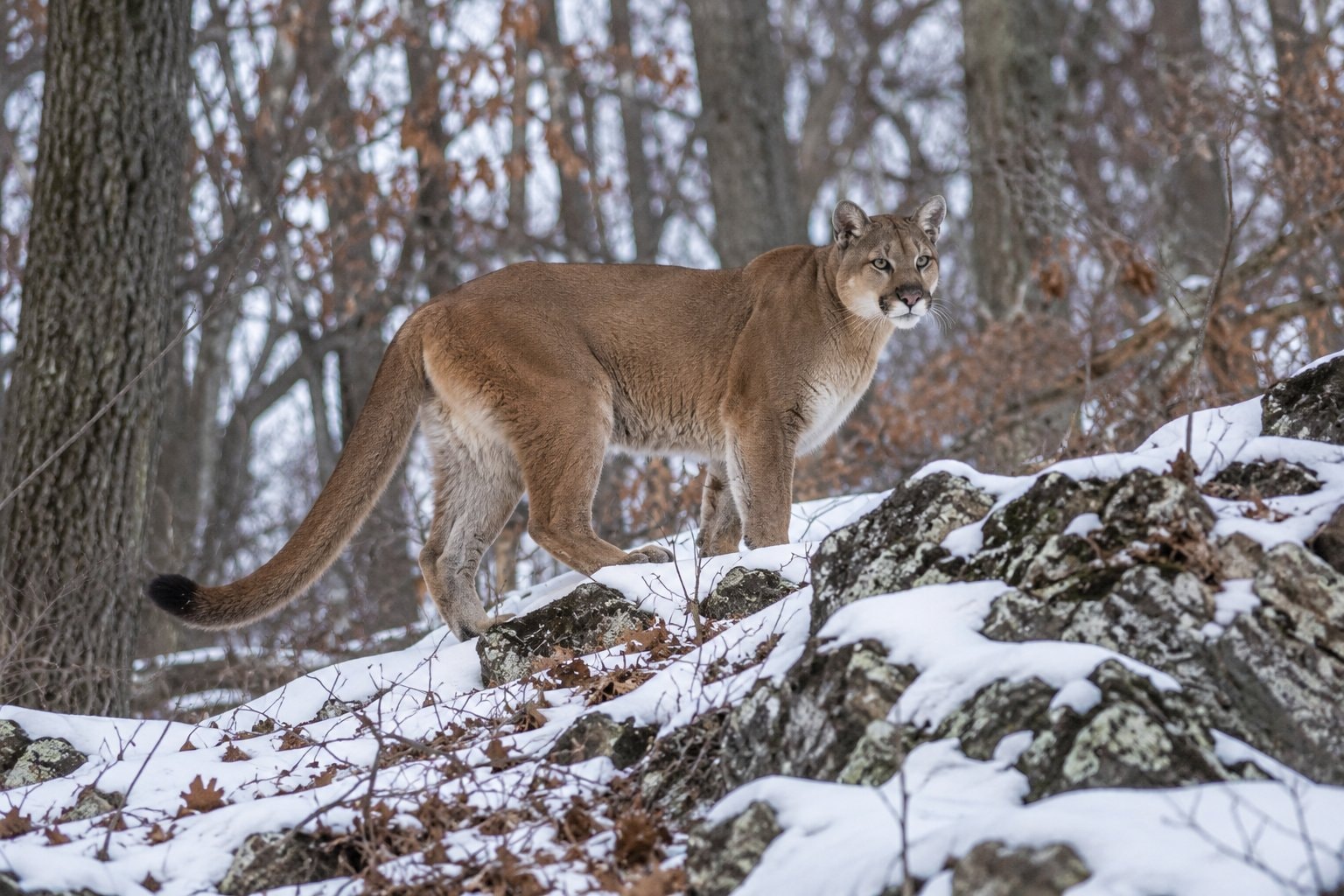
A cougar can cross a state line without establishing a population. That distinction sits at the center of the Midwest story. A photograph can document a cat in the woods; it cannot, by itself, show that females are raising young nearby. The Illinois Department of Natural Resources describes individual mountain lions moving through Illinois, while the Missouri Department of Conservation describes wandering animals arriving from the west. The records are real. The conclusions need to stay as small as the evidence.
A cat built for cover
Cougar, puma and mountain lion are names for the same species, Puma concolor. Its long, heavy tail is an important part of its outline: a slender body, powerful hindquarters, a small head and rounded ears without tufts. The Missouri Department of Conservation's mountain lion field guide describes adults with fairly uniform coloration, unlike the spotted body and short tail of a bobcat. A glimpse of brown fur is a poor identification; the whole shape matters.
The same guide describes a preference for vegetative cover or rocky ground in places with little human habitation. Shelter may be a crevice, hollow tree, bank or patch of tall vegetation rather than a permanent den. Deer are important prey, along with smaller mammals. The cat stalks and ambushes rather than conducting a long open pursuit. These are useful details for understanding the animal, not reasons to seek it out or approach it.
Young males leave their birth areas to seek territories. Missouri's field guide reports that genetic samples from some animals passing through the state point to western origins, and that no breeding population has been demonstrated there. Movement is therefore a better starting point than a map shaded as though every observation represented an established colony. The cougar questions page separates appearance, behavior and status more fully.
Illinois lost its resident cats
According to Outdoor Illinois Journal's account for the Illinois Department of Natural Resources, habitat loss and unregulated hunting eliminated mountain lions from Illinois before 1870. The account describes animals that had once been common and had acted as top predators of deer and other game. Their disappearance was a change in the region's wildlife, rather than evidence that the species was never native here.
Recent visitors do not erase that history. Outdoor Illinois Journal says there is no evidence of a resident breeding population in Illinois. DNA from previously documented animals was similar to that of mountain lions in South Dakota, strongly suggesting dispersal from a western population. The account also explains why photographs from different counties can concern the same individual: these cats travel, and repeated observations do not automatically add up to separate animals.
Outdoor Illinois Journal reports that SB3049 took effect January 1, 2015, adding mountain lions to the protected species in the Illinois Wildlife Code. Protection and population status answer different questions. A protected animal can still be a rare visitor. The journal says mountain lions may not legally be hunted, killed or harassed unless an imminent threat to a person or property exists; concerns belong with the state agency.
The eastern puma finding
The U.S. Fish and Wildlife Service's final rule in the Federal Register determined that the eastern puma subspecies was extinct and removed it from the federal endangered wildlife list. The rule distinguishes that finding from documented pumas appearing east of established western populations. Its assessment says recent validated eastern records outside Florida involved animals from captivity or wild cats dispersing from western North America.
An eastern location does not make a cougar a surviving eastern puma. Nor does the federal finding mean a western cougar cannot enter Illinois. A subspecies assessment, a state protection rule and an observation of an individual all have their own scope. Keeping those meanings apart avoids turning a wildlife record into a much larger claim about ancestry or population size.
A southern Illinois confirmation
ABC7 Chicago reported on September 17, 2026 that IDNR had received multiple mountain lion sightings in Jackson and Union counties and believed they concerned the same animal. That is an agency-confirmed occurrence in the southern Illinois landscape, with no basis in the report for declaring local reproduction. The confirmed Illinois records page explains how evidence is reviewed and how counts are described.
For a walker, the useful next reading is cougars and people, which sets out agency encounter guidance. For the shorter-tailed cats, the blynx feature looks at bobcats, Canada lynx and documented hybrid reports. A careful natural history leaves room for surprise while requiring evidence for each conclusion.