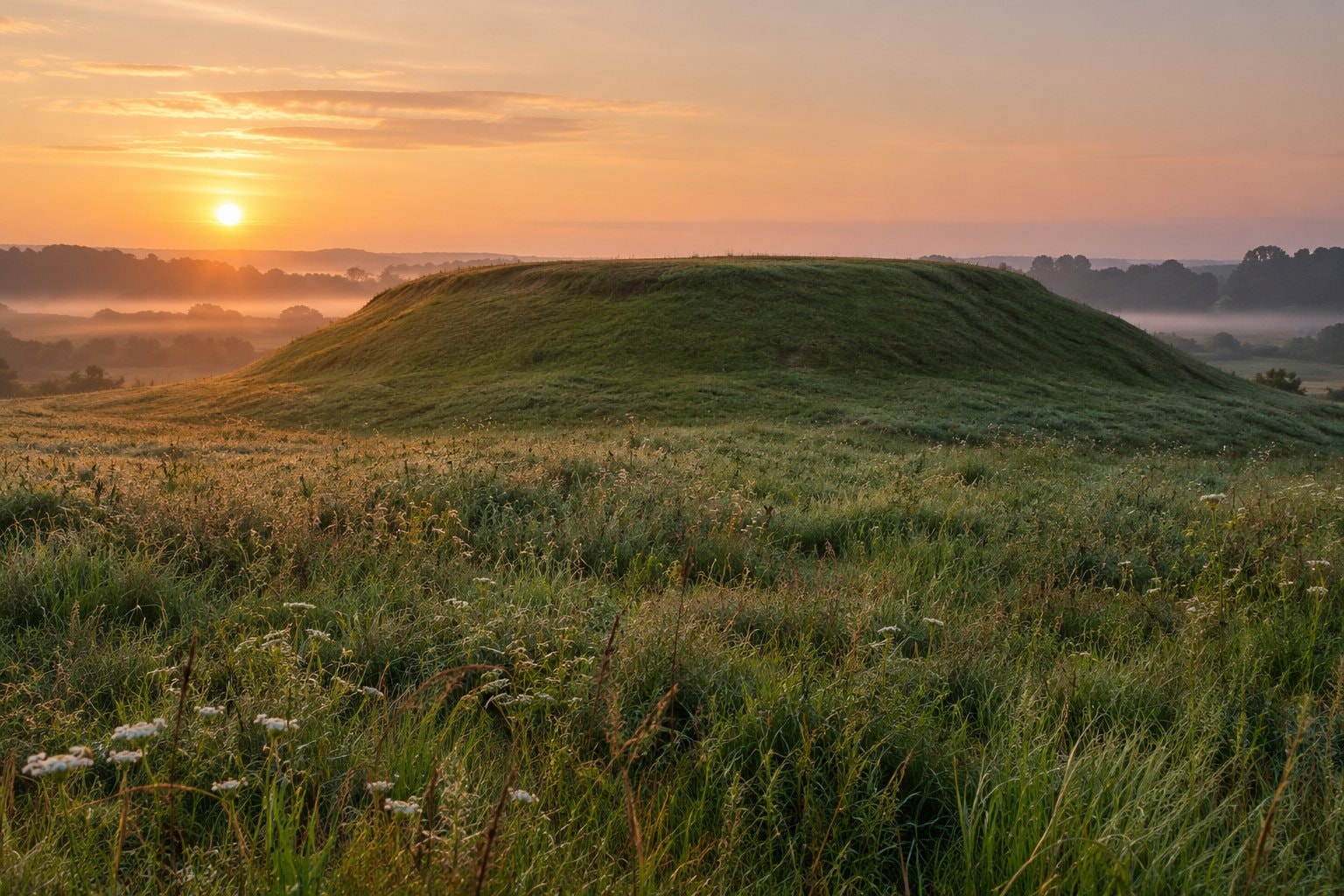
The Mississippians were Indigenous societies whose settlements, farming and earthworks changed much of the eastern North American landscape. The term describes an archaeological period and associated cultural patterns, not a single tribe with an identical way of life everywhere. In southern Illinois, the American Bottom and Cahokia give those patterns a particularly substantial setting. The mounds belong to the history of the people who made and used them.
Wikipedia's Mississippian-period account places the era from the end of the 10th century to the 16th century. It describes population centers, religious governance and a strong emphasis on maize agriculture. The account also makes an important qualification: the transition from the earlier Woodland period was incomplete. Older crops and practices continued alongside changes in settlements and authority.
A floodplain for settlements and fields
Wikipedia's American Bottom article identifies the area as the Mississippi floodplain in the Metro East part of southern Illinois, extending from Alton to the Kaskaskia River. It describes rich alluvial soils and the region's role as a center for the Cahokia civilization. Marshes, swamps and river-formed lakes remain part of the account of its riparian setting.
The floodplain is therefore more than the flat ground below a famous mound. It was a setting for agriculture and communities, and it retains a history of changing water and river channels. The American Bottom article also discusses later changes caused by clearing riverbanks and by floods. Reading the ancient settlement in a floodplain context keeps earth, crops and water in the same picture.
The Mississippian-period account emphasizes maize without saying that every older crop vanished. That continuity matters. A new staple or an expanding center does not instantly replace all earlier knowledge. Farming supported settlements, while the social and ceremonial uses of those settlements give a fuller view than a description of crops alone.
Mounds and authority
Wikipedia's mound-building overview discusses varied earthwork forms, including platform mounds, rounded cones and ridges. It identifies Monks Mound at Cahokia as a major flat-topped structure associated with ceremonial and political leadership. Earthworks were parts of settlements with other mounds, stockades and distinct areas of activity. Their shape has to be read beside their setting and use.
The term mound builders covers cultures from different periods, as the same overview explains. It does not name one separate people or a formal archaeological culture. Mississippian mounds belong to a particular part of that longer Indigenous history. A shared practice of moving and shaping earth does not erase differences in time, community or purpose.
The account of Mississippian society and the Wikipedia article on the Southeastern Ceremonial Complex link this world with chiefdom-level social organization. That describes a pattern of concentrated authority, rather than a guarantee that every settlement had the same hierarchy. Cahokia's size and central role need to be understood within those wider relationships.
Shared images, local expressions
The Southeastern Ceremonial Complex is a modern scholarly name for similarities in Mississippian artifacts, imagery, ceremonies and mythology. Its article discusses shared styles alongside regional variation. The label is useful for recognizing relationships, but it should not be treated as the name of a single institution directing every community.
The account describes a major expression of this imagery associated with Cahokia and other regional styles combining borrowed ideas with local traditions. It also describes styles diverging as major centers declined and trade networks changed. Similarity and difference are both part of the story. A recognizable motif may show a connection without documenting every belief held by the people who used it.
The ancient astronomy feature considers how seasonal sun positions have been interpreted at Cahokia. The same care is needed for imagery: a measured alignment and a proposed religious meaning have different supports. Mississippian history is substantial enough to leave some questions open rather than fill them with a neat universal explanation.
The false separation of builders and descendants
Wikipedia describes a 19th-century belief that the mound builders were an ancient race unrelated to the Indigenous peoples encountered by Europeans. It discusses that claim as the Mound Builder myth. The article's modern overview instead identifies the earthworks with Indigenous cultures, and its historical accounts describe Native American communities using and constructing mounds. That evidence conflicts with the imagined separate race.
The myth is not an additional explanation to keep beside the evidence as though both were equally supported. It obscured the achievements of Indigenous societies. Read the mounds as their work, with the differences among cultures and periods intact. For another regional place where material evidence and interpretation meet, see Fountain Bluff; for a much later southern Illinois craft tradition, see the Kirkpatrick pottery of Anna.