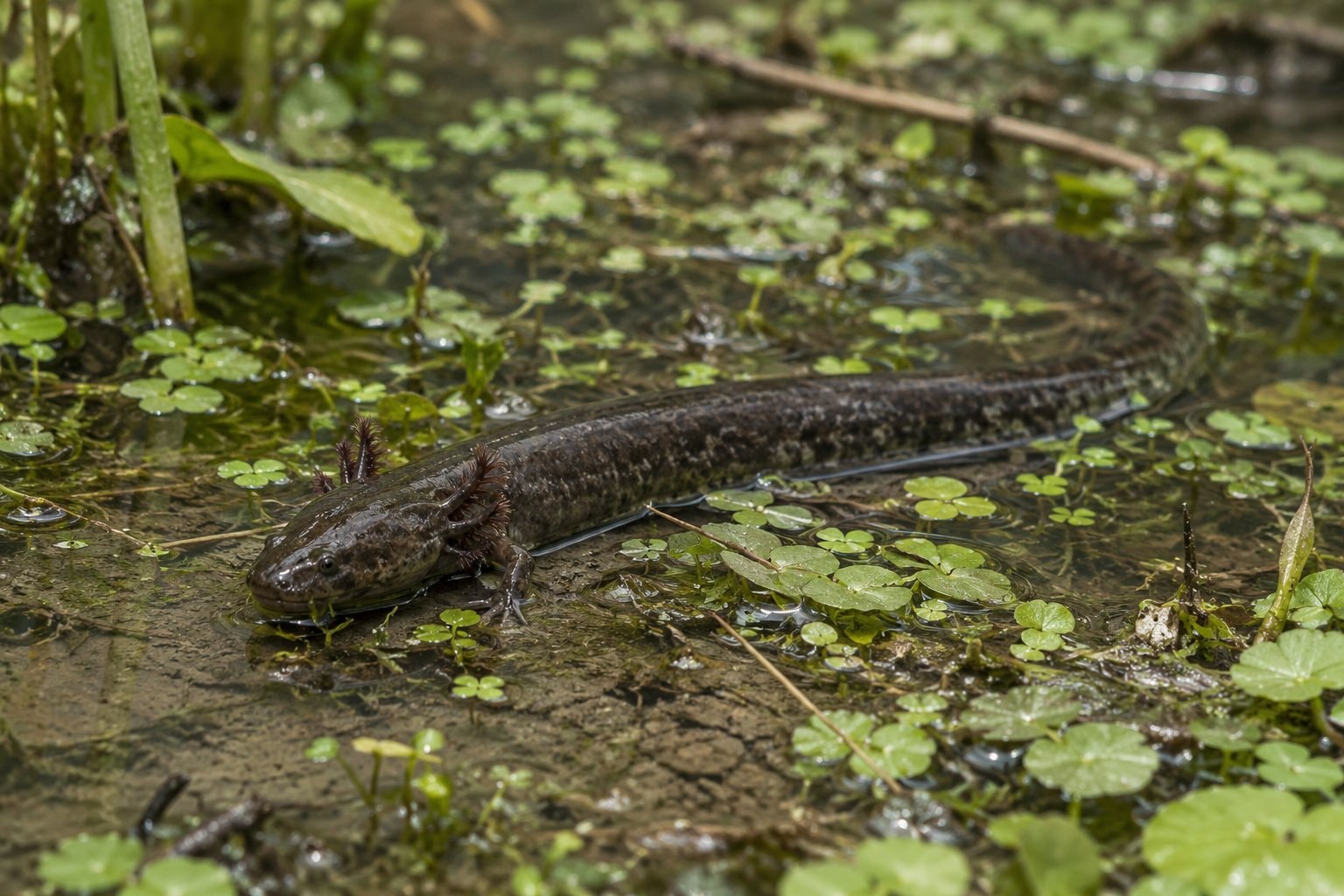
A siren can look like an eel until the details come into view. The body is long and slippery, but small front limbs and feathery external gills identify a salamander. Sirens are amphibians of the family Sirenidae, permanently associated with water. Quiet swamps and ditches hold this unusual form of salamander life, very different from a small animal walking beside a rocky spring run.
The Missouri Department of Conservation's western lesser siren guide describes a dark gray, brown or nearly black animal with a lighter belly, tiny eyes and no hind limbs. Bushy gills sit behind the head. Its wetland range in Missouri follows the eastern side of the state near the Mississippi River and extends into southeastern Missouri.
A salamander that keeps its gills
Many familiar amphibians change markedly between their aquatic young and adult forms. Sirens retain features associated with the larval stage. Animal Diversity Web's lesser siren account calls this paedomorphosis: an adult keeps larval characteristics. In this case, external gills remain part of the adult body. Growing up does not require turning into a terrestrial salamander.
The limbs are reduced rather than replaced with fish fins. An elongated body does much of the work of moving through water, vegetation and mud. Eels and lampreys are fishes; the siren is a salamander. A quick impression of shape is less useful than noticing the combination of gills, small front limbs and amphibian skin.
Sirens also differ from the lungless brook salamanders. Wikipedia's lesser siren account describes respiration through gills, lungs and skin, including life in water with little oxygen. A wetland animal should not be assigned a breathing system merely because another salamander family lacks lungs.
Names do not always line up
The name lesser siren often accompanies the scientific name Siren intermedia. Regional references differ in how they treat the western form. The Missouri field guide uses Siren nettingi, while the Animal Diversity Web account discusses western lesser sirens within Siren intermedia. Wikipedia's account of the genus Siren lists the western siren separately.
That difference is worth noticing when moving between references. It does not turn a siren into a different kind of animal on the page. The shared natural-history features remain an aquatic salamander with an elongated body, external gills and reduced front limbs. Common names make a useful entrance to a subject, but scientific treatments may place their boundaries differently.
Hidden in the quiet water
Sluggish streams, ditches, ponds, sloughs and swamps provide suitable habitat. Animal Diversity Web describes a preference for shallow, warm, slow-moving water with vegetation and organic debris. Murky water does not exclude these animals. Thick plant growth and submerged material provide places to remain out of sight.
During daylight a western lesser siren shelters beneath aquatic plants, roots or branches. At night it searches around the bottom and vegetation. Aquatic insects, worms, small crayfish and snails are among its food. Chemical cues help it locate prey in the conditions where small eyes offer a limited view.
This is a predator working within the wetland, not an intruder into it. Other animals also eat sirens; the Missouri account names mudsnakes, minks and great egrets among their predators. Much of the activity is hidden by darkness and water. The absence of a visible siren on a daytime visit says little about whether one lives there.
When the pond becomes mud
A wetland that dries is not necessarily beyond a siren's tolerance. The animal can burrow into bottom mud and form a mucus covering that limits water loss. Its activity and metabolism fall during a dormant period called aestivation. This is a response to drying conditions, rather than the familiar picture of winter hibernation.
The Missouri guide describes the coating as becoming like parchment as the surrounding mud dries. Animal Diversity Web discusses the use of stored fat and reduced metabolism during this interval. When rain refills the habitat, activity can resume. A pond's dry appearance therefore does not make its living inhabitants expendable.
Leave the wetland company in place
Western lesser sirens breed in spring, with eggs associated with bottom mud or aquatic vegetation. The Missouri guide describes a male guarding the nest, moving his tail to circulate water and keeping the eggs clean. Reproduction adds another reason to keep submerged cover and vegetation undisturbed. Observe the habitat without catching, handling, keeping or feeding its wildlife.
Beavers can change the amount and arrangement of quiet water in a landscape. The brook salamanders show a contrasting life around springs and rocky forest streams. The natural events calendar places both kinds of amphibian habitat beside the changing seasons, without making the unseen animals any less part of the day's walk.