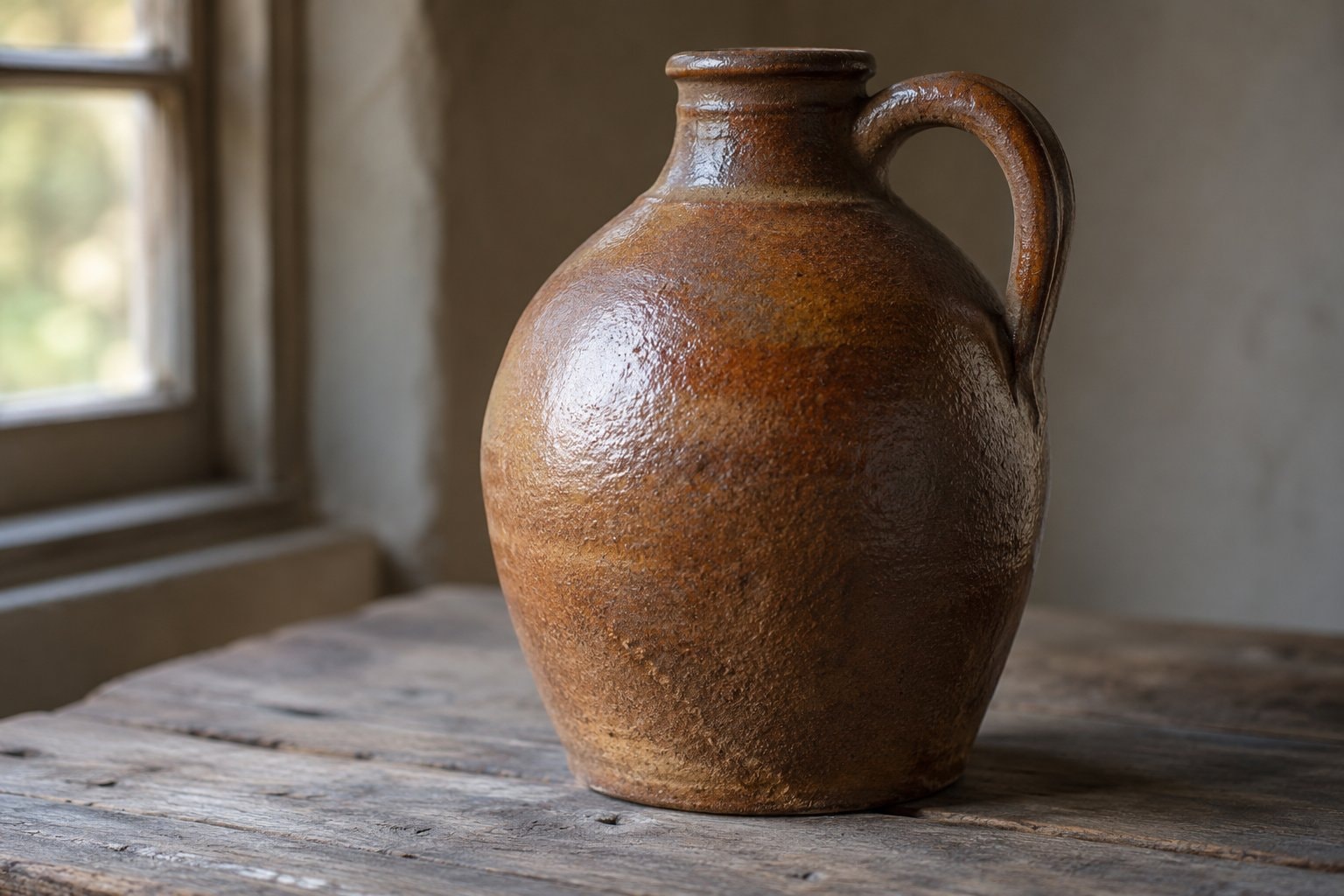
The Kirkpatrick pottery at Anna made objects for ordinary use and objects that refuse to remain ordinary. Crocks, pipes and garden vessels belong to the practical side; pig flasks and snake-covered jugs belong to a more theatrical one. The same workshop brought those purposes together. Its work offers a southern Illinois history written in clay, where a vessel can store something and also make a visual joke.
Wikipedia's Anna Pottery record dates the pottery to 1859–1910 and names its founders as the brothers Cornwall Kirkpatrick and Wallace Kirkpatrick. It places the pottery in Anna, in Union County, Illinois, and records stoneware and white clay ware among its products. The record says the brothers came after moving from Mound City and Washington, Pennsylvania. Those details place the workshop in a regional setting rather than reducing it to a collection of unusual objects.
Useful work paid its way
The Southeast Missourian's account of Anna Pottery describes utilitarian wares alongside eccentric ceramic pieces. Pipe bowls were routine products. Stoneware crocks, drainage pipe and garden urns also came from the pottery, with novelty vessels sharing the workshop's skills and materials. The article presents the useful output as an important part of the context for the more elaborate work.
A crock asks for a sound body and a workable opening. A drainage pipe asks for a different useful shape. A figural flask can bend that same concern with containment into something comic or unsettling. Keeping those objects together makes the craft more intelligible: the Kirkpatricks were potters working in vessels, surfaces and fired clay, rather than artists whose practical work can simply be ignored.
The Southeast Missourian describes pig-shaped flasks, snake-covered pots and political messages incorporated into the pottery. It also records railway maps incised on pig flasks, with the arrangement sometimes used to express disfavor toward particular towns. That turns the surface into more than decoration. A recognizable place and an unlikely animal shape can share a vessel without forming a sober geographic document.
Clay, body and surface
Stoneware is pottery fired at high temperature until its body becomes dense and resistant to water. The name describes the fired ceramic, not a vessel carved from solid stone. Wikipedia's stoneware account distinguishes this material from other ceramic categories and notes its use for both tableware and decorative pieces. A practical crock and an elaborate jug can therefore share a material without sharing a purpose.
The Southeast Missourian reports that the Kirkpatricks had a southern Illinois source of kaolin clay for their whitewares. Kaolin is clay rich in the mineral kaolinite; Wikipedia's mineral account describes kaolinite as soft, earthy and usually white. The local material belongs in the pottery's history, but it does not identify every piece's recipe. White clay ware and darker stoneware should not be treated as interchangeable labels.
Wikipedia's salt-glaze account explains a glossy, translucent surface with a slightly pebbled texture, formed when salt introduced during firing reacts with the clay body. The visible finish is thus a result of the kiln process, rather than simply a color painted onto the object. The glaze may be clear or colored. A surface description helps a viewer notice texture and light before deciding what a figure or inscription means.
Not every dark surface is a salt glaze. The Krannert Art Museum's snake jug is described as stoneware with dark brown slip and applied and incised decoration. Slip, glaze, modeled additions and cut lines refer to different features of a ceramic object. Read the particular museum description rather than applying a general finish to every piece associated with a pottery.
What the snakes might mean
The Krannert Art Museum's Anna Pottery snake-jug account identifies Wallace Kirkpatrick as its designer and describes snakes tangled across the vessel with human figures. It says little is known about the reception of the figural pieces in their own time. That opening qualification is important: an elaborate image can invite an interpretation without documenting how its first audience understood it.
The museum discusses an earlier scholarly reading of snake jugs as temperance warnings. It then describes more recent interpretations emphasizing grotesque imagery, humor and an extravagant style, understood as an ironic challenge to Victorian values. These are attributed readings, not a verdict that every snake jug delivers the same message. The objects can be examined closely while leaving the disagreement visible.
The distinction between description and interpretation is especially useful here. Snakes, figures, modeled relief and incised details are things a museum can describe on an object. A warning about drink or a satire of social values concerns intended meaning. The museum's account supplies both kinds of discussion but does not claim that the surviving vessel settles every question about the Kirkpatricks' outlook.
Anna, exhibitions and collections
Anna's local history in Wikipedia ties the town's beginnings to an Illinois Central Railroad station. The pottery belongs to that town and county setting. It should not be pictured as a lone workshop detached from settlements and transport. For another view of the region's places and travel history, Fountain Bluff brings the river landscape into the picture.
Wikipedia records Anna Pottery exhibits at the 1876 Philadelphia Centennial and the 1893 World's Columbian Exposition. It also lists holdings at the Missouri History Museum, Illinois State Museum, Metropolitan Museum of Art, and Winterthur Museum, Garden and Library. The Southeast Missourian records collections at Stinson Library in Anna and the Union County Museum in Cobden. These statements concern holdings described by those sources, rather than current hours or an invitation to a private collection.
The pottery sits beside other ways of reading the southern Illinois landscape. The Mississippians considers earthworks, agriculture and regional societies; ancient astronomy considers how material evidence is interpreted. The Kirkpatrick wares ask a related kind of care: look closely at what an object is, what a source documents, and what remains a reading of its meaning.