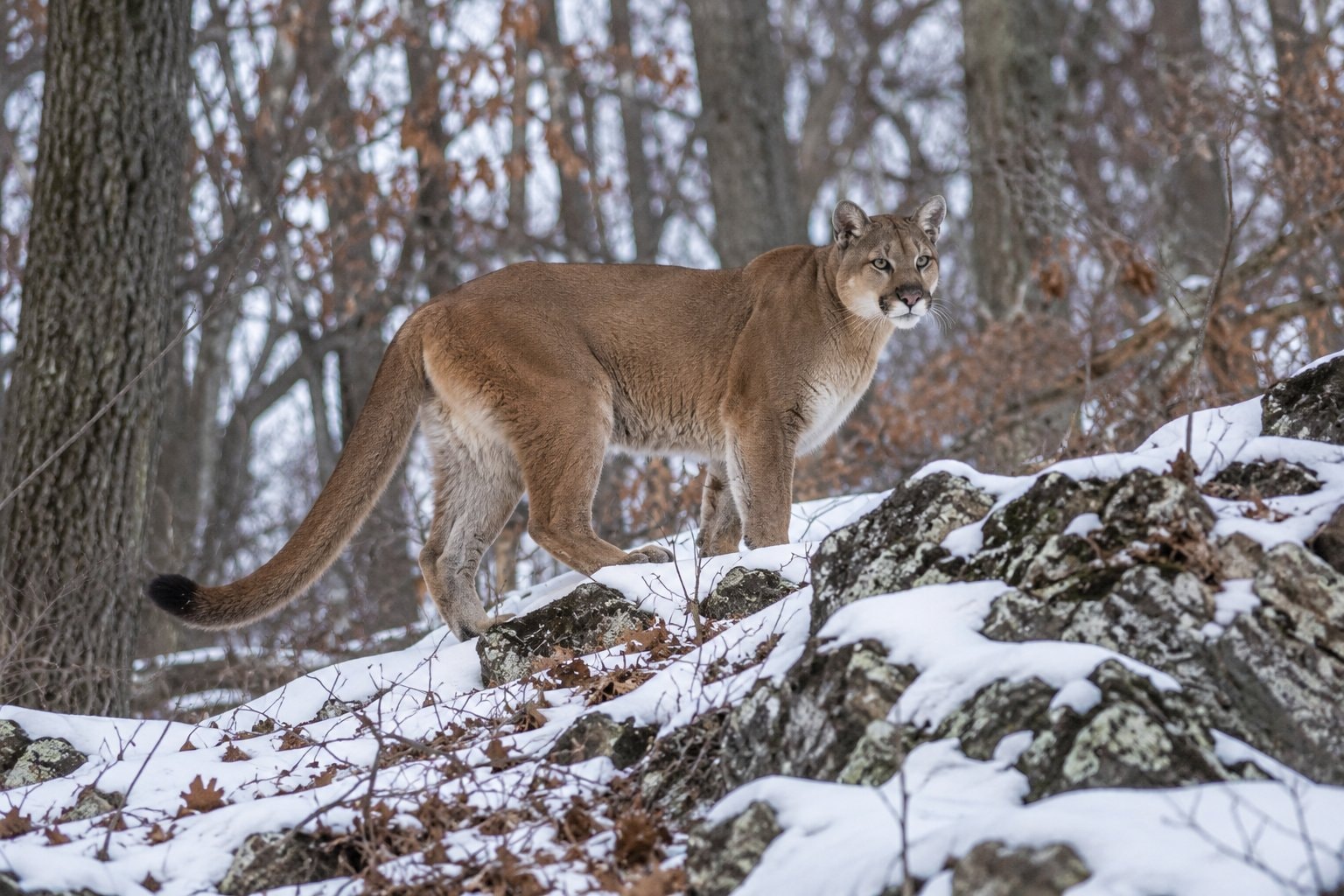
A confirmed cougar record is more than a confident description of a large cat. It involves evidence that can be examined and tied to a place. That may mean original photographs, recognizable tracks and an agency review of the surroundings. The Illinois Department of Natural Resources' Wildlife Illinois account describes this work as confirming the species and location. It does not treat every reported glimpse as a new animal.
The Jackson and Union county record
ABC7 Chicago reported on September 17, 2026 that IDNR had received multiple sightings of a mountain lion in Jackson and Union counties in far southern Illinois. The agency believed the sightings concerned the same animal. That qualification matters: a cat can be photographed or seen repeatedly while moving through the landscape, and a set of observations is not necessarily a set of separate cats.
KFVS12 described it as the 12th confirmed mountain lion in Illinois since 2002. Its report also said that IDNR believed the county sightings involved the same animal. The station attributed earlier animals' western origins to DNA analysis, with Nebraska and the Dakotas considered likely sources. Those findings concern previously examined animals; they do not supply a genetic result for every cat subsequently photographed.
According to the same KFVS12 report, previous animals had been 2-to-3-year-old males. Young males dispersing from western populations are a different story from a demonstrated population of breeding females and young in Illinois. The county confirmation is worth recording without extending it beyond what IDNR and the reports say.
Earlier evidence, carefully counted
Outdoor Illinois Journal's state-agency account describes the disappearance of Illinois mountain lions through habitat loss and unregulated hunting, followed by documented individual visitors. It discusses physical records, DNA and trail-camera photographs. The account notes that images from nearby counties may show the same animal, given the distances cougars can travel.
Those distinctions prevent a misleading tally. Counting photographs, sightings, counties and confirmed individuals can produce different totals. A sequence of photographs may describe a route. DNA may address origin. Neither automatically gives a count of animals living permanently in the state. The journal explicitly says there is no evidence of a resident breeding population in Illinois. A rare visitor does not need to be renamed a resident to be an interesting wildlife record.
The Midwest cougar feature sets these Illinois records beside the broader dispersal story. The emphasis belongs on documented movement and on the limits of inference. An absence of breeding evidence is not a reason to dismiss a clear photograph; a clear photograph is not evidence of reproduction.
What the state asks to see
Wildlife Illinois explains how IDNR reviews mountain lion reports. It asks for original images of the animal or its tracks, with information that helps identify the location. For tracks, the agency describes photographs of individual prints, groups of prints and the wider area. An object of known size in a photograph helps reviewers judge scale. This is a description of evidence collection, not an invitation to approach an animal.
The account says a state biologist reviews the material and attempts to confirm the species and location. Send a sighting to IDNR through the agency's own reporting guidance rather than treating a personal guess as a public record. Keep a safe distance. Wildlife Illinois says not to approach a mountain lion and not to run from one. The full attributed encounter guidance appears on cougars and people.
Ordinary animals, difficult glimpses
Wildlife Illinois lists domestic dogs, domestic cats and bobcats among the animals most often mistaken for mountain lions in Illinois. A cougar has a long, heavy, dark-tipped tail and a largely plain adult coat. A bobcat is smaller, has a short tail and carries spotted markings. During a brief view, the shape of a partly hidden tail can matter more than an impression of size.
The agency also describes large dog and coyote tracks being mistaken for cougar prints. Its comparison explains that cats retract their claws while walking, and it points to the arrangement of the toes and pads. A blurred print or a partial impression can leave these features uncertain. Photographing the broader track pattern gives a reviewer more to work with than choosing the most catlike print.
For identification and status together, read cougar questions answered. A confirmed record is a useful, bounded conclusion: this species was present at a documented place. It leaves population size, breeding and future residence to other evidence.