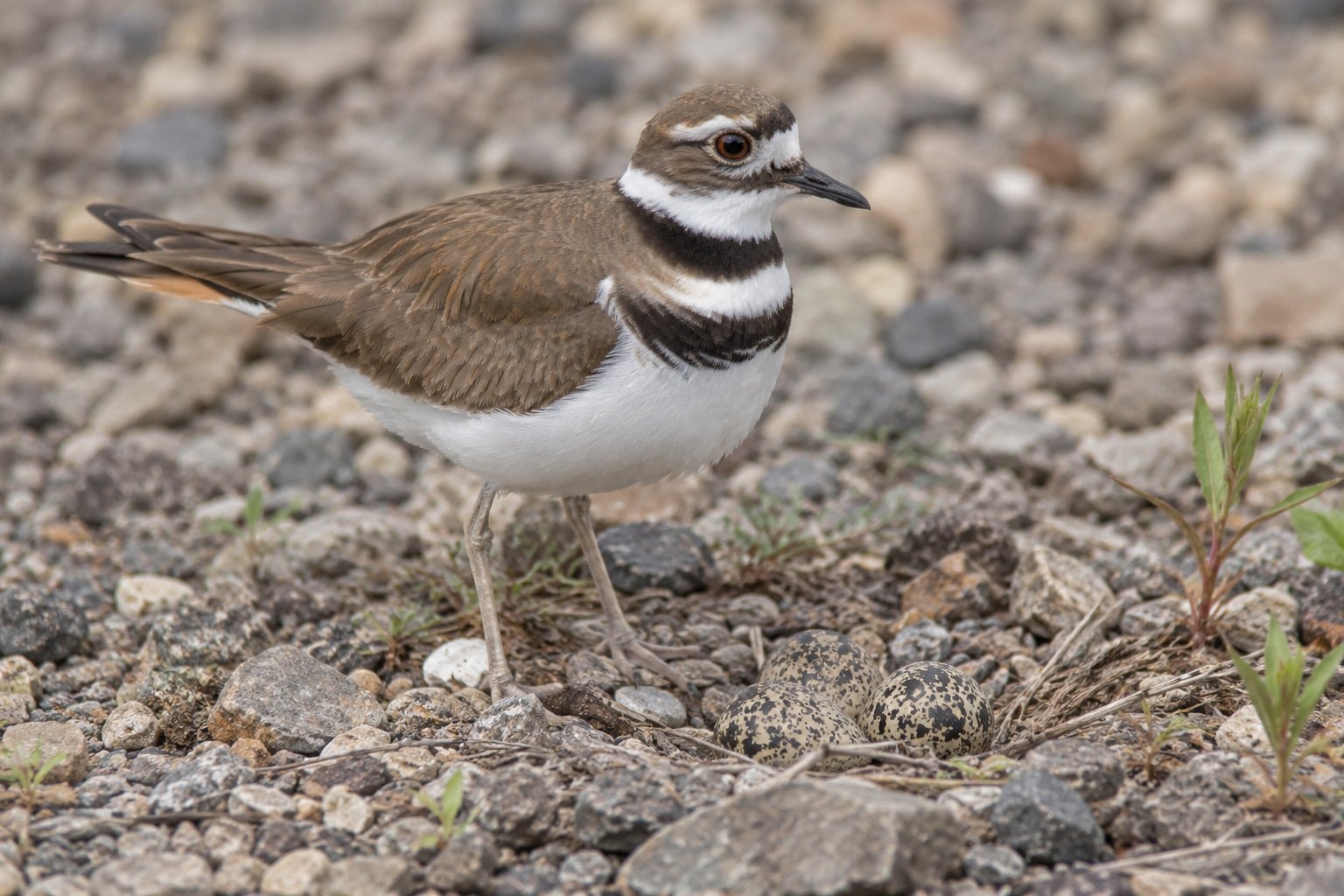
The killdeer, Charadrius vociferus, is a plover that need not be standing on a beach. Fields, lawns, gravel lots and other open ground can supply its habitat. Its brown upperparts and white underside suit a bird seen against soil and stones, while bold dark breast bands help make an adult recognizable. The loud call may announce it before a moving bird is found.
The Missouri Department of Conservation's killdeer guide describes the run-and-stop style of a plover. A killdeer moves a short distance, pauses and picks prey from the surface. That visual search differs from a sandpiper probing with its bill. Watch the rhythm as well as the plumage.
Open ground is working habitat
Killdeer prefer flat, open places with bare ground or very short vegetation. A field or lawn can therefore serve a shorebird even at a distance from a shoreline. Flooded fields, muddy margins and pond edges also provide feeding opportunities. Human alteration has supplied new-looking settings for an old set of needs.
Audubon's field guide notes nests on lawns and gravel roofs as well as other open ground. It also emphasizes good feeding habitat for chicks, including shallow water. Nesting surface and nearby food need not look identical. A bird using gravel may be connected to a wetter feeding patch beyond it.
Insects make up much of the diet, accompanied by other small invertebrates such as worms, spiders and snails. The stop in a run-and-stop sequence is a chance to detect and take food. An observer standing still can learn more from that pattern than from following the bird closely enough to interrupt it.
The nest scarcely looks like a nest
A killdeer nest is a shallow depression in soil or gravel. It may contain pebbles, grass, twigs or little lining at all. The eggs are pale buff with darker markings, blending with the rough surface around them. The nest does not need a cup of woven vegetation or a branch above it to be complete.
This makes casual ground use a source of conflict. A bare patch useful to people may also hold eggs. A bird lingering on open gravel is reason to watch before proceeding. Give the occupied area room without touching eggs, adding material or attempting to move the nest. Its camouflage works best when the surface remains the setting the bird selected.
Nesting can be preceded by courtship flights and nest-scraping behavior. A territorial bird may call from the air, moving above ground that otherwise looks empty. The sounds and movements add context to the scrape. Not every bird standing near gravel is nesting, but conspicuous behavior can reveal that the ground has a purpose beyond its human use.
The broken wing that leads away
An adult may crouch, flutter and hold a wing as if injured while moving away from eggs or young. The orange rump and contrasting tail and wing markings can become prominent. It is a distraction display directed at a potential predator or intruder. The apparent injury shifts attention from a hidden nest to an obvious adult.
Wikipedia's killdeer account describes the adult moving away from the nest before displaying, with alarm calls and other movements drawing attention. Responses vary with the stage of breeding. The performance is part of nest defense, not a request for a person to pursue or pick up the bird.
If this happens nearby, withdraw and give the area space. Searching for the eggs defeats the point of a careful encounter. The bird's behavior has already supplied the useful information: vulnerable young or a nest may be close, and attention is unwelcome.
Downy young soon leave the scrape
Killdeer chicks hatch covered in down and can move about soon afterward. They leave the nest and feed themselves, but parents continue to tend them. Mobile young should not be mistaken for abandoned young. A small bird standing away from the original scrape can still be within an actively cared-for brood.
Both parents share incubation and care. They may brood the young while the chicks move about their feeding ground. The adult's watchful presence can be more apparent than the tiny young themselves. Stop short of the family rather than making the parents keep shifting their attention toward a closer observer.
Life beside ordinary activity
Killdeer have adapted to many human-used places, yet their ground nests remain exposed to disturbance and predators. Familiarity does not make a brood safe from vehicles or a nest safe from feet. Space and a brief, distant view are practical ways to let the birds carry on.
The wild turkey offers another ground-nesting comparison, with very different cover around its nest. The reptile eggs page considers hidden nests in soil, while the natural events calendar places nesting and migration among the year's changes. The killdeer adds a lesson in noticing life on ground that first seemed bare.