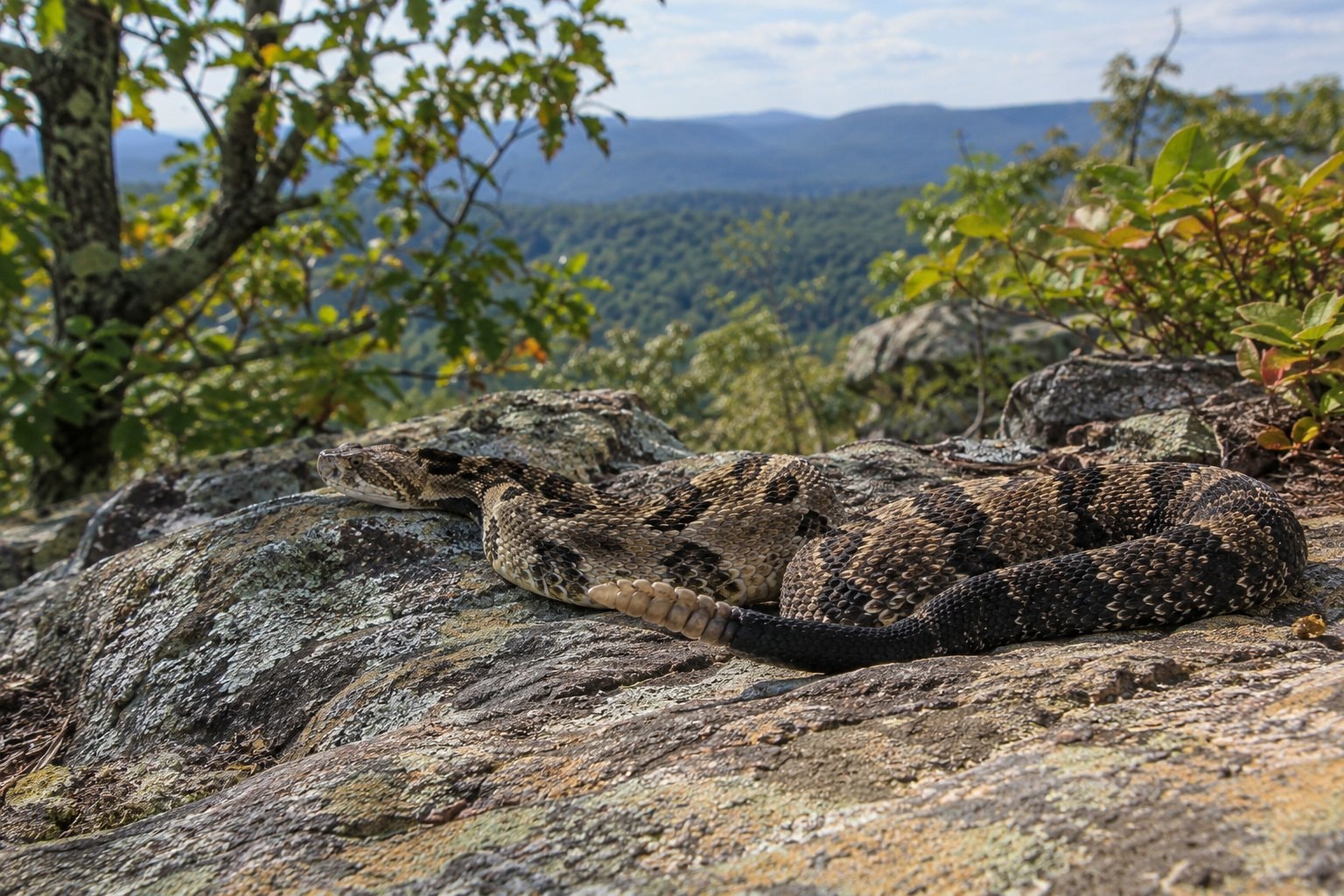
The timber rattlesnake, Crotalus horridus, belongs to the wooded, rocky side of the regional landscape. Its dark bands and variable brown, gray or yellow background can disappear among leaves, branches and stones. A snake lying still may be avoiding notice, waiting for prey or digesting a meal. Stillness is part of its life, not assurance that a close approach is safe.
Venomous snakes deserve distance, and so do snakes whose identity is uncertain. Do not handle, corner or kill them. The useful natural-history view takes in the animal, its shelter and the surrounding ground while leaving a route for it to move away. Identification is not a test that must be completed at arm's length.
Bluffs, shelter and the changing season
The Missouri Department of Conservation's timber rattlesnake guide describes mature forest, rugged wooded hills, ledges and bluffs as important habitat. Rock crevices and similar protected places provide winter dens. In some areas snakes gather at such sites; in other areas, suitable shelter is more dispersed and large gatherings are less typical.
Spring and autumn can bring basking on sunny rock ledges. Summer heat shifts much activity toward dusk, dawn and night. These patterns help explain why a species can live in wooded hills without being seen often by daytime walkers. An absence of sightings is not an inventory of what the hillside contains.
Timber rattlesnakes feed mainly on small mammals, including rodents, and sometimes take birds. Their venom serves feeding as well as defense. As predators they belong to the same food web as their prey and the birds and mammals that may eat young snakes. The animal's ecological role does not remove the need for human caution.
The rattle is a warning, not a calendar
A tail rattle can signal alarm, but a snake may remain silent. The Missouri guide warns that a surprised animal may not sound its rattle and that tails can be damaged. Silence cannot establish that a snake is harmless. Give the same space to a quiet animal that would be given to an audible one.
Rattle segments are added with shedding, while older segments may break away. Their count does not reveal a snake's age. The rattle is part of an animal growing and weathering in its habitat, not an annual tally. Close inspection is unnecessary to understand that difference.
Conservation does not erase danger
Wikipedia's timber rattlesnake account lists the species as threatened in Illinois. The Missouri field guide records local declines associated with habitat loss, persecution and poaching. A species can have a broad overall range while disappearing from particular places. Its presence on a wooded bluff is consequently neither a reason for alarmed destruction nor a reason for casual handling.
The walking the hills page considers the ground beneath a walker's feet. Around rocks and logs, look where feet and hands will go and avoid reaching into hidden spaces. Leaving a den or sheltered snake undisturbed keeps observation from becoming an encounter at close quarters.
Copperheads and cottonmouths
The eastern copperhead, Agkistrodon contortrix, has dark hourglass-like crossbands on a tan, coppery or grayish background. It uses wooded hillsides, creek-side cover and other places with rocks, logs and leaf litter. Its pattern blends into dead leaves. Like the timber rattlesnake, it can remain motionless rather than making its presence obvious.
The cottonmouth, Agkistrodon piscivorus, is a venomous snake associated particularly with water, including marshes, shallow lakes and sluggish streams. Its pale mouth lining is used in a threat display. Do not provoke an animal into displaying its mouth to settle an identification. Water is habitat for harmless snakes as well, so location alone cannot decide the name.
A watersnake is not a cottonmouth
Wikipedia's common watersnake account describes Nerodia sipedon as nonvenomous and frequently mistaken for a cottonmouth. Young or clearly patterned animals have bands and blotches; older animals can become dark enough that the pattern is obscure. Fearful attention to a dark body near water is a poor substitute for careful identification at a distance.
The small ring-necked snake is another harmless regional example. It lives a secretive life under cover and may expose a brightly colored underside when threatened. Bright color does not by itself establish danger to people. Leave these animals alone, including when an identification seems certain.
A bite requires immediate help
According to MedlinePlus, anyone bitten by a snake needs emergency medical care at once; folk first aid has no place. Its guidance says not to wait for symptoms and warns against cutting the wound, sucking venom, applying ice or using a tourniquet. Do not pursue, trap or pick up the snake.
The reptile eggs and hatchlings page explains another part of snake life without collecting animals. The natural events calendar places activity and winter shelter in their seasonal setting. A distant observation can add to a day's understanding without changing the animal's day.