Cougar questions often mix identification, population status and safety. The answers below keep those subjects separate, using wildlife-agency accounts rather than unverified reports.
- Are cougars and mountain lions the same animal?
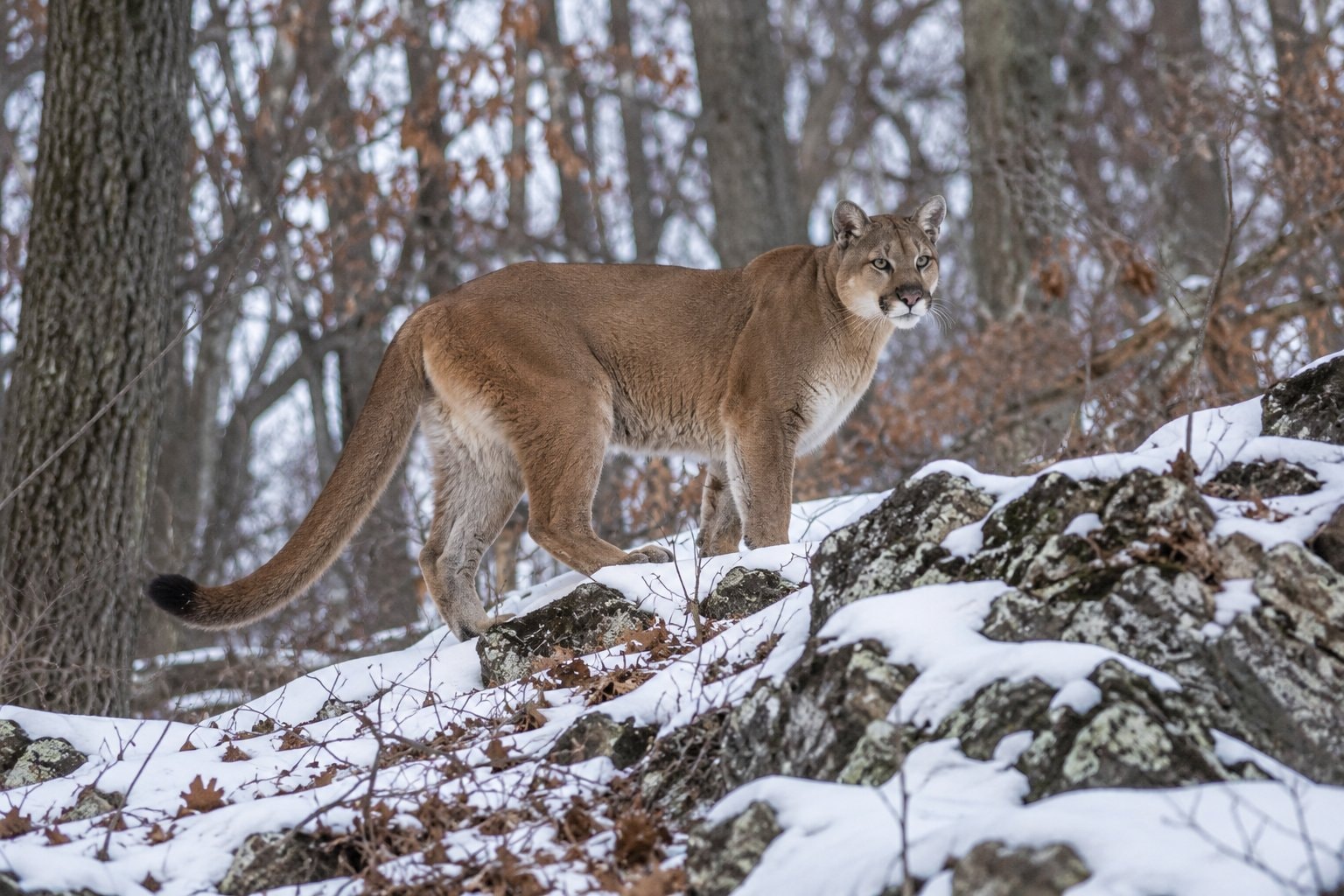
Yes. Wildlife Illinois calls the species mountain lion, cougar or puma; its scientific name is Puma concolor. Regional common names do not describe separate Illinois animals. The state account describes a tan or tawny cat with rounded ears, pale undersides and a long, dark-tipped tail. Identifying that body shape is more useful than deciding which familiar name to use for an uncertain glimpse.
- What does an adult cougar look like?
Wildlife Illinois describes a largely plain tan coat, pale chin and inner legs, rounded ears and a heavy tail tipped with black. Young mountain lions have spots, so a spotted coat does not describe every life stage in the same way. For an adult seen briefly, note the tail, body shape and ears together. A patch of color disappearing into brush gives much less information than an unobstructed view.
- How large is a cougar?
Wildlife Illinois gives average adult male weights of 115 to 160 pounds and adult female weights of 75 to 110 pounds. Those are the account's stated averages, rather than a weight estimate for any particular animal photographed in Illinois. Apparent size changes with distance and perspective. The long tail and overall proportions are useful to record, while a known scale is helpful when an agency reviews photographs of tracks.
- What do cougars eat?
The Missouri Department of Conservation describes deer as a favorite food, with elk and smaller mammals also taken. The guide lists rabbits, beavers, opossums, raccoons, skunks and coyotes among those smaller prey. Cougars are ambush predators that stalk before attacking at close range. Their food does not come from a single prey species, and seeing suitable prey in a woodland does not establish that a cougar lives there.
- How many cougars live in Illinois?
The agency accounts describe confirmed individuals moving through Illinois, rather than a measured resident population. Outdoor Illinois Journal explains that photographs from different counties can show the same animal. A count of records therefore cannot be substituted for a count of permanent residents. The confirmed Illinois records page covers the documented county reports and explains why the number of photographs and the number of animals may differ.
- Is there evidence that they breed in Illinois?
Outdoor Illinois Journal states that no evidence of a resident breeding population exists in Illinois. Documented visitors are compatible with that statement: presence and reproduction are different questions. An animal seen repeatedly may be moving through a broad area. Neither repeat sightings nor suitable-looking cover demonstrates local young. The agency's conclusion leaves room for confirmed individuals without adding a breeding population that its evidence does not show.
- Where do the wandering animals come from?
Outdoor Illinois Journal reports DNA similarity between previously examined Illinois animals and mountain lions from South Dakota, strongly suggesting western dispersal. The Missouri Department of Conservation likewise describes young males leaving their birth areas in search of territory. These findings concern documented animals and a known dispersal pattern, rather than a proven origin for every later photograph. The Midwest return story explains that distinction in context.
- How can a bobcat be distinguished from a cougar?
Wildlife Illinois compares the long-tailed cougar with the smaller, short-tailed bobcat. Bobcats have spotted markings, a facial fringe and usually tufted ears; adult cougars have rounded ears without that tufted outline. Spots may be hard to see in a brief view, so the whole shape matters. The blynx feature discusses bobcats and Canada lynx, whose reported hybrids are a separate question from cougar identification.
- How dangerous are cougars to people?
The National Park Service describes mountain lions as elusive but unpredictable and potentially dangerous. It advises against approaching them and says to give them an escape route. A distant sighting is not an attack, and rarity does not mean an encounter can be ignored. Stay with the agency's concrete guidance instead of judging the cat's intentions from its expression. The cougars and people page covers the evidence and precautions.
- What about livestock or other animals on a property?
The Missouri Department of Conservation's account recognizes possible conflicts involving livestock and domestic animals. In Illinois, Wildlife Illinois directs people who feel that a person or property is threatened to IDNR for available options. A sighting alone does not establish livestock loss or identify the cause of an injury. Keep the animal's space and let the agency assess a concern rather than attempting to pursue, corner or handle it.
- Are mountain lions protected in Illinois?
Outdoor Illinois Journal says SB3049 took effect January 1, 2015, adding mountain lions to the state's protected species. The account says they may not legally be hunted, killed or harassed unless an imminent threat to person or property exists. It directs concerns to IDNR. This describes the agency's published status information; a legal protection is not evidence of a resident breeding population and does not turn a visitor into a permanent resident.
- What do agencies advise during an encounter?
Wildlife Illinois says not to run or approach. It advises making your presence known, standing upright, appearing large, slowly backing away and moving together if in a group. The National Park Service also advises facing the animal, avoiding crouching and allowing an escape route. Both accounts say to fight back if attacked; Wildlife Illinois says not to play dead. These are agency instructions for an encounter, not a reason to test the animal's reaction.