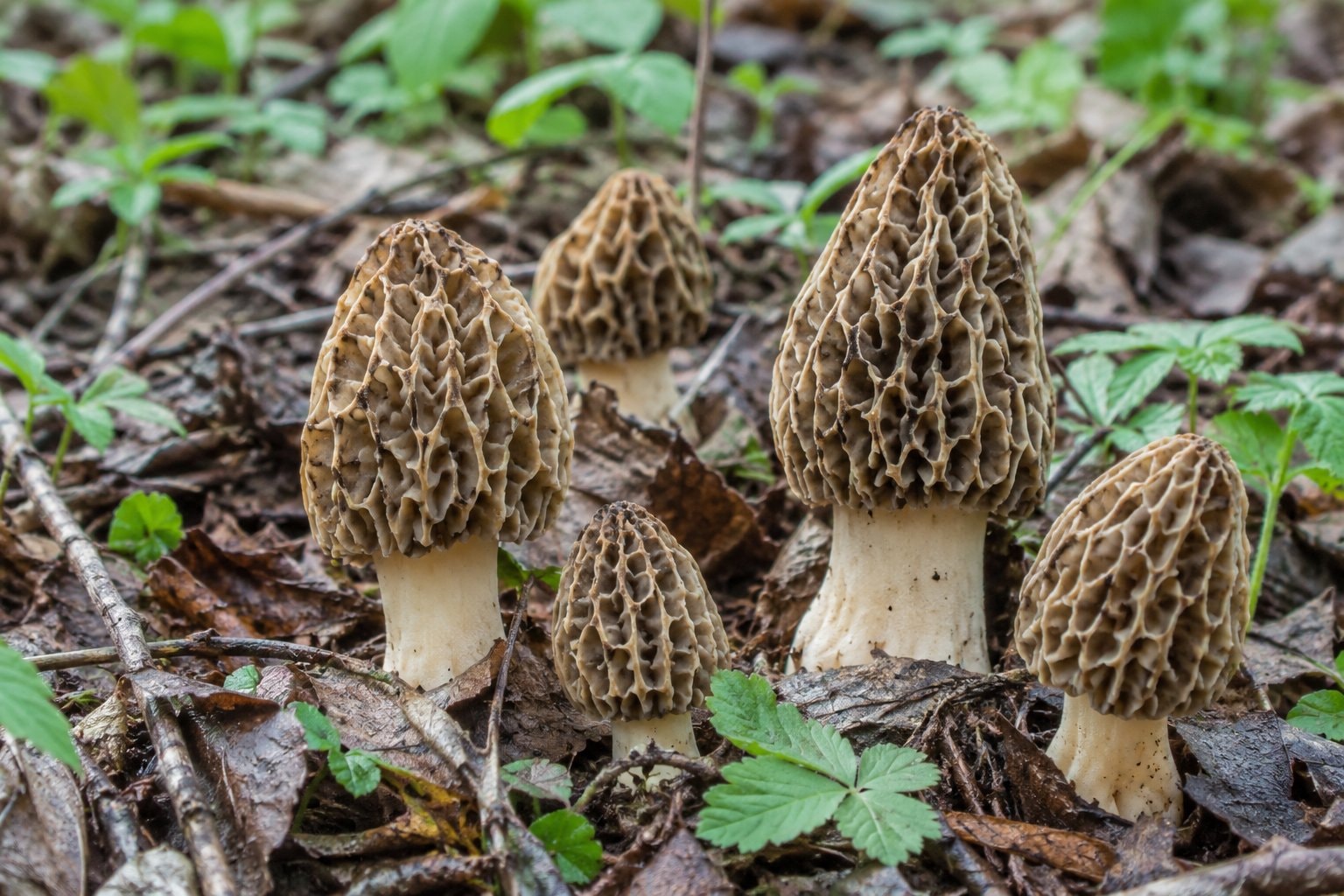
Morels belong to the fungal genus Morchella. Their caps have a network of pits and raised ridges, giving a honeycomb-like surface that can be difficult to pick out against spring leaf litter. They are fungi, not plants, and the part above ground is only a brief visible structure. A spring walk can begin with the pattern of a cap and lead toward a much larger life in the soil.
The Missouri Department of Conservation's morel guide describes moist woodland and river bottoms among their habitats. Ash trees, dying elms and apple trees are frequent associations, but morels also occur elsewhere under hardwoods and conifers. A favored tree is context for looking, not a guarantee of a mushroom's identity or presence.
The fungus beneath the mushroom
Most of a morel's life is spent as mycelium, a network of fungal cells associated with soil, roots and decaying material. The mushroom is a reproductive structure. Spores are released from the pits in its cap. A visible cluster is consequently not a small stand of plants growing from seeds.
The Missouri guide describes connections with tree roots and the decomposition of leaves and wood. Fungi join living roots, dead material and soil processes in ways that a brief view of a fruiting body cannot fully show. The same walk can hold ghost pipe and other non-green plants, whose lives reveal different links between roots and fungi.
Spring timing, varied forms
True morels in the Missouri guide are spring mushrooms. Their forms include black, yellow and half-free morels. Pits and ridges remain important features, while cap color and attachment differ. In a half-free morel, part of the cap hangs away from the stem; in the other forms described, its lower edge joins the stem.
True morels are hollow inside. False-morel caps often have folds, lobes or wrinkles instead of the pitted surface, and their interiors can be chambered. These are useful biological comparisons, but they are not permission to eat a specimen after a quick visual check. A page, photograph or remembered feature cannot settle every possible look-alike.
False morels are not a cooking challenge
Wikipedia's account of Gyromitra esculenta describes a potentially deadly false morel and reports that thorough cooking does not remove all of its toxins. The Missouri guide recommends regarding all so-called false morels as toxic. Their resemblance to true morels is the reason for the name, not evidence of shared safety.
Anecdotes about someone having eaten a mushroom before are no substitute for identification and safety. False morels vary, and similar outlines can hide important differences. Treat the uncertain mushroom as a subject for observation. There is no useful need to turn uncertainty into a taste test.
The clear boundary for eating
Never eat a wild mushroom unless an expert has identified it with certainty, following the identification caution in the Missouri Department of Conservation's guidance; false morels are poisonous, as Wikipedia's false-morel account explains; and even true morels must be thoroughly cooked, with a study in Clinical Toxicology warning especially about raw or undercooked preparations.
That study examined morel poisonings recorded by French poison centers and reported severe complications. Its findings concern true morels, not simply mistakes involving false morels. The familiar label edible therefore does not mean safe raw. Thorough cooking is an essential caution, not a method for making unidentified or poisonous mushrooms suitable to eat.
Identification is an independent task
Wikipedia's mushroom-hunting article describes accurate identification as essential and notes that cap, gill and stem features can matter; some distinctions require microscopy. The practice draws people outdoors and rewards attention, but certainty comes from expertise with the actual mushroom and its look-alikes. A general resemblance is a starting point, not an answer.
Misidentification is a central risk in mushroom poisoning. The possibility of poisonous look-alikes gives study a practical boundary. For a naturalist, an unknown mushroom can remain unknown while its setting, shape and surrounding plants are recorded. A photograph and an observation need not become a meal.
Look at wood as well as ground
The oyster mushroom, Pleurotus ostreatus, presents a different form: broad fan-shaped caps, gills below and a connection to wood. It decomposes dead and dying hardwood, returning material to the forest's nutrient cycles. The contrast with a pitted morel illustrates how varied fungal fruiting bodies can be. It does not remove the need for certain identification before any eating.
The natural events calendar places the spring morel season beside other woodland changes. A year can also bring the very different white ribbons described on the frost flowers page. Both reward noticing the forest floor, while only one is a fungus.