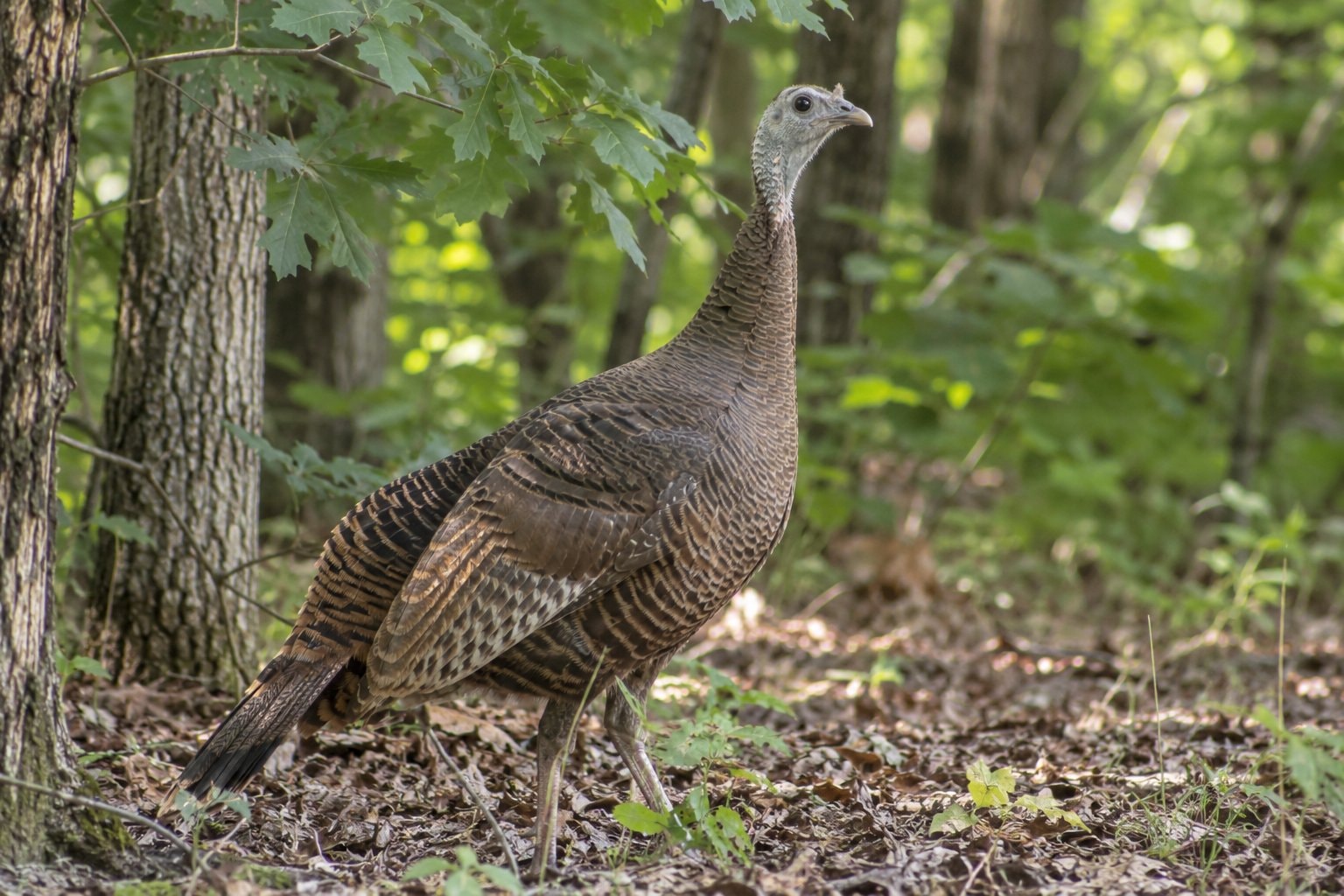
The wild turkey, Meleagris gallopavo, has a social history in both senses: people have moved and domesticated it, and wild birds live through changing social arrangements of their own. Winter flocks, spring displays and hens leading young belong to that living year. The large bird at the edge of a wood is neither simply barnyard poultry nor merely a symbol of a holiday meal.
A dark body can flash bronze in the light. Males are larger and more iridescent than females, with bare, colorful heads and fleshy wattles. The familiar gobble is only part of the bird's range of sounds. Seeing the bird in motion adds still more: a turkey can walk, run and take strong flight.
Mexico, Europe and a bird carried back
Wikipedia's wild turkey account identifies a southern Mexican wild turkey as the ancestor of domestic turkeys. Indigenous people in Mexico domesticated the bird; domesticated turkeys were later carried to Europe. European settlers in turn brought domestic turkeys into northern North America. A native American bird thus became familiar abroad before returning as a farm animal to another part of its own continent.
That history distinguishes ancestry from appearance. Domestic breeds have been shaped by people, while the wild turkey remains an animal of woodland, openings and ground-level food. The related ocellated turkey is a different species and is not the source of the familiar domestic bird. The story begins with a wild population in Mexico, not with a European poultry yard.
Scarcity and a different kind of return
Habitat loss and hunting reduced wild turkey populations sharply. The species disappeared locally from parts of its range. Familiarity with the domestic bird could coexist with scarcity of its wild relative; seeing turkeys on farms did not mean that wild flocks remained in the surrounding woods.
The Wikipedia account describes early reintroduction attempts with hand-reared birds as unsuccessful because those birds did poorly in the wild. Later work relied on wild populations and the movement of wild birds into suitable unoccupied areas. This explains a conservation history; it is not a practice for an individual observer to attempt. Wild turkeys should remain wild.
Reintroduction brought the bird back across much of its former range. The Missouri Department of Conservation's field guide describes a major increase associated with conservation work, but also notes more recent declines across much of the eastern United States. A return is not a promise that habitat will always remain adequate.
A hen needs more than a patch of trees
The Missouri guide explains the balance needed by a nesting hen: enough ground cover to hide her and the nest, with enough openness to allow escape. Young turkeys, called poults, also need a particular arrangement. Broadleaf plants and flowers provide cover, while spaces among them allow movement and insect foraging.
Woodland and openings therefore work together. A stand of trees alone does not describe all that is needed for nesting and raising young. Ground-level vegetation can be too sparse for concealment or too dense for small poults to move through. The structure below a walker's knees matters to a bird seen towering over the grass as an adult.
Food through the seasons
Turkeys scratch through leaf litter and search for a wide range of foods. Spring brings green growth and insects alongside remaining acorns. In summer, insects, seeds and berries contribute to the diet. As autumn progresses, seeds, grain and other plant foods become more important; winter especially brings reliance on hard mast, including acorns.
Poults depend heavily on insects soon after hatching. Adults take a broader menu, but the insect-rich low vegetation that shelters young also supplies food. Habitat and feeding cannot be separated cleanly. The butterflies and moths page considers another set of lives that depends on plants at different stages, from caterpillars to flying adults.
Ground nests and treetop nights
Audubon's wild turkey guide describes ground nests in shallow depressions, often beside a tree, under a shrub or among grass. A hen incubates and tends the young. Downy poults leave the nest soon after hatching and feed themselves under her care.
Adult turkeys commonly roost in tall trees at night. Spring males spread their tails, puff their feathers and strut to attract females; winter brings flocking. These different sights are parts of the same annual life. A quiet hen in cover is as much a turkey observation as a displaying male.
The killdeer provides a useful comparison with another ground-nesting bird whose downy young soon move about. The natural events calendar places both birds among seasonal changes. Watch turkeys from a distance, without feeding them or pressing toward a hen and young, and the history remains attached to a living animal.