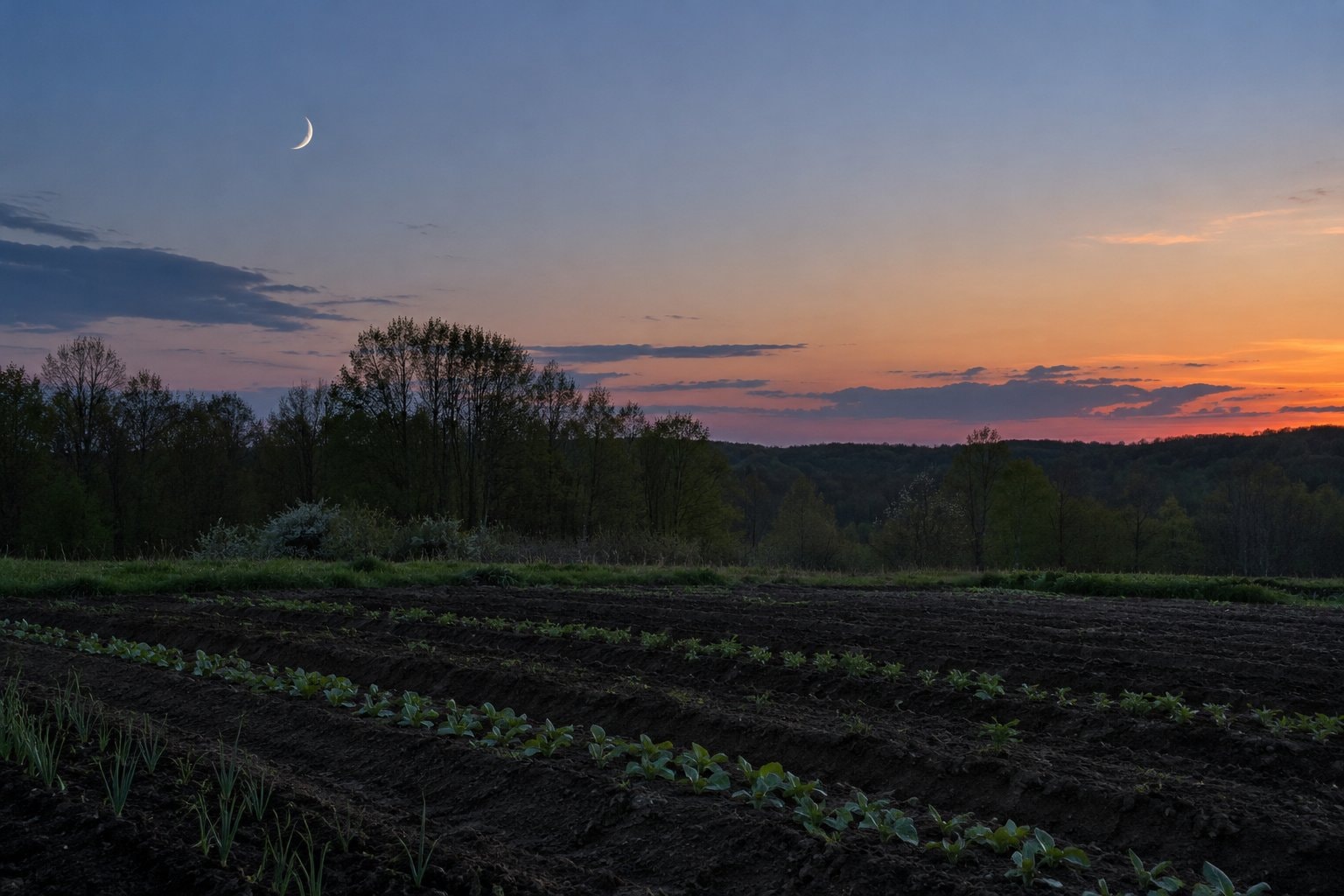
The sky has rhythms that cross the garden fence without consulting the garden. A moon phase repeats, the Sun’s seasonal path turns, and Earth meets trails of space debris. Understanding those different rhythms makes an almanac easier to read. The familiar words do not all describe the same sort of event: a full moon is a phase, an equinox is a moment in the solar year, and a meteor shower is an encounter with a stream of small objects.
The Moon changes its appearance
NASA’s explanation of moon phases begins with reflected sunlight. The Moon produces no light of its own; sunlight illuminates its day side, and the portion visible from Earth changes as it orbits. The shadowed part seen in an ordinary crescent is not caused by Earth’s shadow. Moon phases follow the changing view of the sunlit part of the Moon. Keeping that simple geometry in mind removes much of the mystery without removing the pleasure of looking.
NASA lists eight phases in sequence: new moon, waxing crescent, first quarter, waxing gibbous, full moon, waning gibbous, third quarter and waning crescent in its phase guide. Waxing means the visible sunlit portion is growing; waning means it is shrinking. Crescent describes the narrow illuminated shape, while gibbous describes a shape larger than a half disk but short of a full one. The changing appearance belongs to a continuous movement, even though the named stages are convenient stopping points.
NASA gives the repeating cycle as about 29.5 days in its moon-phase account. That is a useful average for understanding the lunar month, rather than a set of dates for a particular calendar. First quarter can sound like a small illuminated sliver, but the name concerns progress through the cycle; the visible face looks half lit. Full moon shows the illuminated face toward Earth. The vocabulary becomes clearer when the shape and the position in the cycle are kept separate.
Seasonal names and solar turning points
Wikipedia’s full-moon reference discusses the harvest moon and hunter’s moon as traditional names. The harvest moon is the full moon nearest the autumnal equinox, and the hunter’s moon follows it. These are seasonal names carrying cultural associations. They do not describe a separate kind of Moon or establish a schedule for planting, fishing or behavior. Other naming traditions differ, so a familiar name is best read with the tradition attached to it.
In Wikipedia’s equinox account, the Sun appears directly over Earth’s equator. In the Northern Hemisphere the spring equinox belongs to March and the fall equinox to September. Daylight and darkness are approximately equal around these events, though the reference explains that they are not exactly equal. The apparent size of the Sun and atmospheric refraction help account for the difference. The tidy name is not quite a tidy stopwatch.
Wikipedia’s solstice reference describes the limits of the Sun’s northward and southward seasonal path. In the Northern Hemisphere, June brings the summer solstice and the longest daylight period; December brings the winter solstice and the shortest. Equinoxes and solstices are astronomical markers. They do not require weather to change on cue. A cold day near the spring equinox and a warm interval in fall do not alter the underlying event.
Meteors belong to another rhythm
NASA distinguishes a meteoroid in space, a meteor in the atmosphere and a meteorite that reaches the ground. A bright streak overhead is the atmospheric event. Its meteor reference describes showers recurring as Earth passes through dusty debris along an orbit. Wikipedia’s meteor-shower account explains why the streaks appear to radiate from a shared region of the sky. The apparent meeting point is a matter of perspective, not a nearby launching place.
The table follows the timing labels in that reference. It groups recurring showers by their broad seasonal placement and retains the caution that some listed showers are periodic. A month label is not a promise of a spectacular display. Conditions and the shower’s behavior still matter. The table supplies names to recognize, while the explanation supplies a way to understand what is being seen.
| Shower | Timing |
|---|---|
| Quadrantids | early January |
| Lyrids | late April |
| Eta Aquariids | early May |
| Arietids | mid-June |
| Southern Delta Aquariids | late July |
| Perseids | mid-August |
| Aurigids (periodic) | early September |
| Draconids (periodic) | early October |
| Orionids | late October |
| Leonids | mid-November |
| Geminids | mid-December |
| Ursids | late December |
Follow the sky’s cultural connections into moon gardening and the solunar fishing idea, where the distinction between a visible cycle and a practical prediction becomes important. Ancient astronomy in the Mississippi valley considers another question: how alignments and seasonal markers are interpreted in the landscape. The same sky can invite observation, tradition and careful historical inquiry.