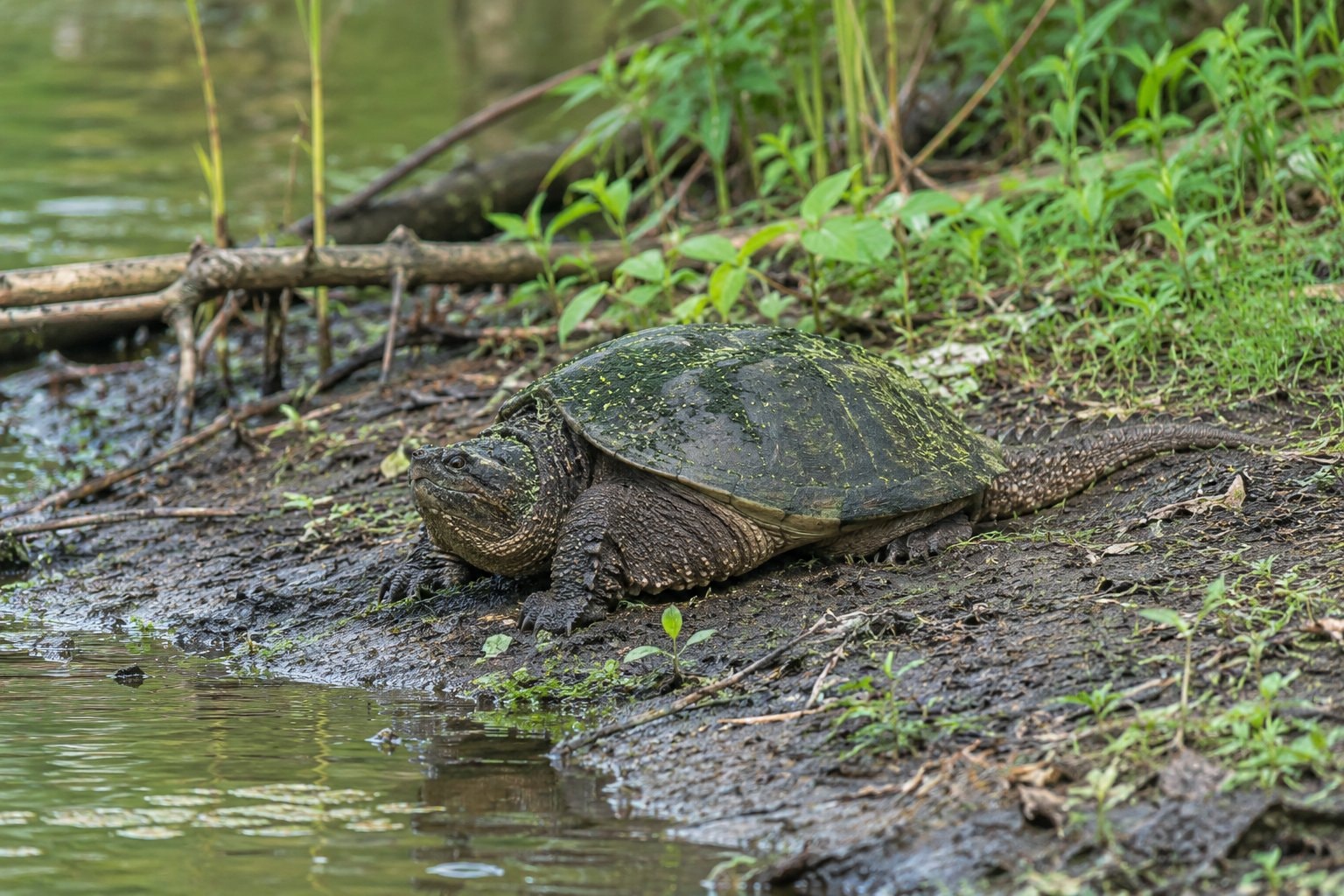
The common snapping turtle, Chelydra serpentina, belongs to muddy water as much as to the dramatic moments when one appears on land. A large head, powerful jaws and a thick, long tail give it a formidable look. Yet much of its life passes quietly beneath the surface, concealed in vegetation or bottom mud. The animal crossing open ground is only a brief view of an aquatic life.
The Missouri Department of Conservation's field guide uses the name North American snapping turtle for the same species. It describes ponds, ditches, marshes, swamps, sloughs, rivers and reservoirs as habitat. Permanent water, a muddy bottom, submerged wood and aquatic plants offer the setting in which its habits make sense.
A shell that does not close the door
The upper shell, or carapace, may be tan, brown or nearly black, often carrying mud or algae. The lower shell is the plastron. In a snapping turtle that lower covering is small, leaving much of the body exposed. The tail bears a sawtooth line of pointed scales, another useful feature in a distant view.
This shell arrangement differs from the closing lower shell of a box turtle. A snapper cannot withdraw its head and limbs into a completely sealed refuge. Its long neck and defensive behavior on land belong to that different body plan. A shell is protection, but turtle shells do not all protect in the same way.
Waiting in the shallows
Animal Diversity Web's snapping turtle account describes muddy bottoms and abundant vegetation as useful concealment. A turtle may settle into the mud with little beyond the eyes and nostrils exposed. Its neck can extend toward the surface for air while most of the body remains hidden.
Snappers ambush prey, but they also walk along the bottom searching for food. The diet is broad: insects, crayfish, snails, fish, amphibians and other animals are joined by aquatic vegetation and carrion. Describing the species only as a fish eater leaves out a substantial part of its role. It is an omnivore and scavenger as well as a predator.
The Missouri guide also cautions against the familiar assumption that snapping turtles necessarily ruin natural fish or waterfowl populations. Their presence is part of an aquatic community. A snapping turtle at a pond need not be made into a problem merely because its jaws are noticeable and its daily feeding is largely unseen.
Why one turns up on dry ground
Wikipedia's common snapping turtle account describes substantial overland travel to reach other habitat or nesting ground. A turtle can be far from the nearest water without being lost. Females seek places with loose soil or sand for their eggs, and drying water can also set turtles moving.
Nesting commonly takes place in late spring and early summer in the Missouri field guide. The female uses her hind limbs to dig, deposits pale eggs with flexible, leathery shells, and covers the nest. The journey joins an aquatic adult life to a terrestrial stage of reproduction. Roads can interrupt that movement, so a turtle in open ground deserves room rather than a crowd around it.
The nest has its own conditions
Egg development is influenced by the nest environment. In snapping turtles, incubation temperature affects the sex of the young. Wikipedia's explanation of temperature-dependent sex determination describes this as a developmental process found in some reptiles. Temperature patterns differ among species; a simple rule borrowed from another turtle is not a reliable account of every nest.
Eggs and young also occupy a different place in the food web from large adults. Raccoons, skunks and other predators eat eggs; small hatchlings face predators both on shore and in water. The nest is therefore part of the surrounding habitat, not an unfinished animal collection. The reptile eggs and hatchlings page explains these stages without removing them from that setting.
Room is the useful response
In water, a common snapping turtle will often hide or move away. On land, it can defend itself strongly. Give it a wide space, do not pick it up, and do not try to hold it by the tail. The Missouri guide warns that tail lifting can injure the backbone. The long reach of the neck also makes a close inspection unwise.
A calm distant view is enough to notice the shell, tail, setting and direction of travel. The natural events calendar places nesting journeys among the year's other movements. Once the turtle returns to cover or water, the most important part of the encounter is that its life can continue there.