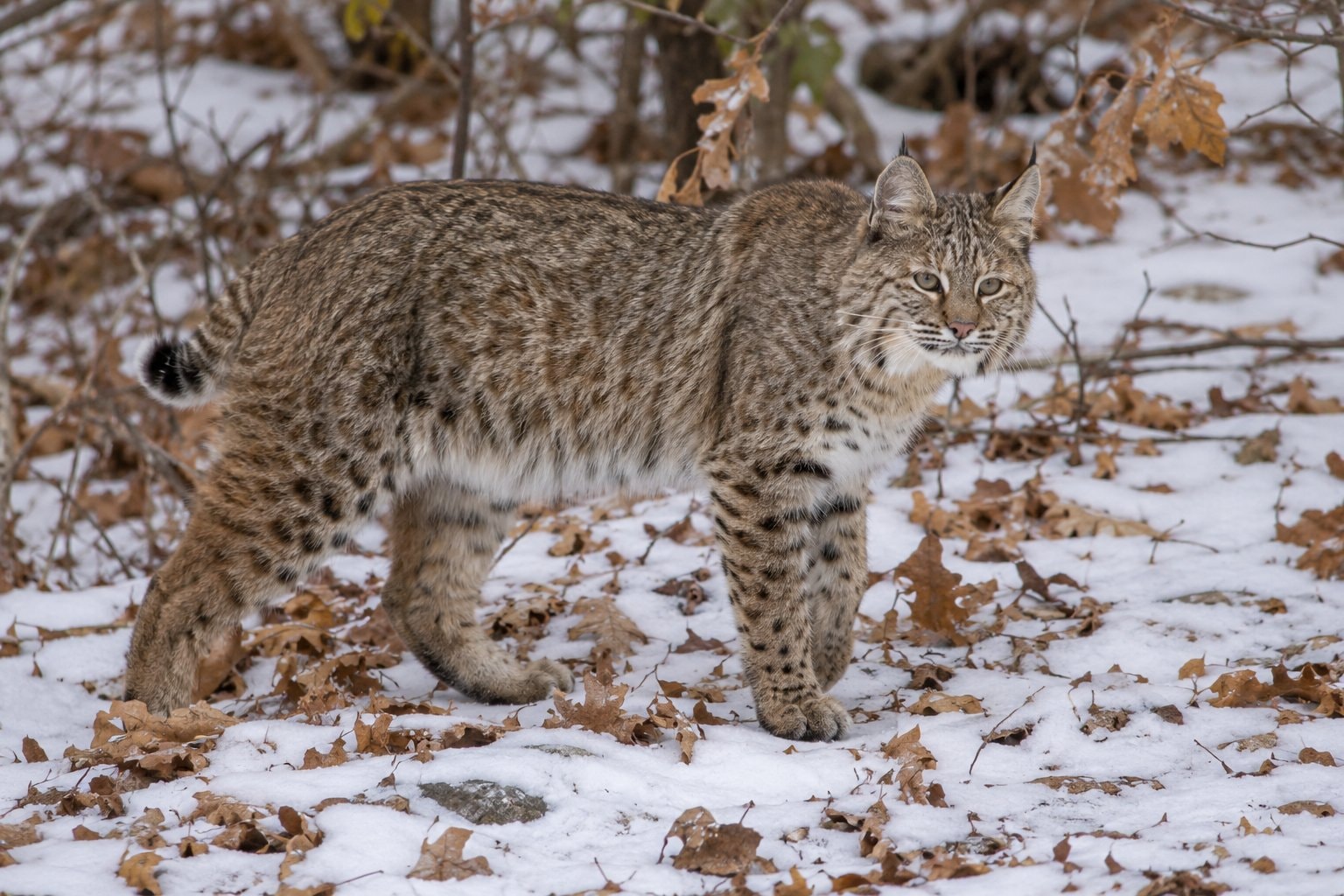
A blynx is the offspring of a bobcat and a Canada lynx. The name sounds like a woodland riddle, but it describes a specific cross between closely related cats in the genus Lynx. It does not mean any cat with odd markings, conspicuous ear tufts or an unfamiliar face. Hybrid ancestry is a question about parentage, and an unusual outline alone cannot settle it.
The reports behind the name
Wikipedia's blynx article says the initial evidence came from genetic analysis in Minnesota. It also records a Maine animal examined by biologists in August 2003 and a reported Michigan female accompanied by kittens. The Michigan report challenged the assumption that such hybrids must always be sterile. A further Maine female is described as giving birth in summer 2003. These are attributed reports about particular hybrids, not a claim that hybrid cats are common across their parents' ranges.
The article describes an intermediate appearance: a short tail like those of the parent species, black ear tufts, a face closer to a bobcat's, and feet between the parental forms in size. Spots may be present or absent. That mixture helps explain the interest in these animals. It also explains the limits of casual identification: no single feature in that description functions as a reliable test of ancestry.
The broader Wikipedia article on felid hybrids places the blynx among crosses within the cat family. It notes that relatively few naturally hybridize even where related cats can produce offspring. Its bobcat–lynx section also warns that unusual-looking animals may be color variants of a parent species rather than hybrids. Read the reports as evidence to evaluate, rather than permission to rename every unfamiliar wild cat.
The bobcat side
Wildlife Illinois, from the Illinois Department of Natural Resources, describes the bobcat as a spotted and streaked cat with a facial ruff, usually tufted ears and a short tail. Its coat varies from yellowish to reddish brown, becoming more grayish in winter. The pale underside also carries dark markings. That changing coat makes a field view more complicated than a neat drawing with every spot plainly visible.
Wildlife Illinois says bobcats occur throughout Illinois and are more common in the southern part of the state. They use forest with a dense understory for cover and denning, with edges and fields for hunting. Rabbits, mice, voles and squirrels are important prey, though the diet includes other animals. An ordinary bobcat therefore fits the southern Illinois woods without requiring an extraordinary hybrid explanation.
The state account describes bobcats as mostly quiet but capable of growls, screams and other calls. Their activity commonly extends from near sunset through the night. A fleeting view in dim light is a difficult identification setting. Tail length, the facial fringe and the pattern of the coat are useful observations, but the absence of a clearly visible mark should not be turned into proof that the animal lacks it.
The Canada lynx side
The U.S. Fish and Wildlife Service's Canada lynx profile describes a boreal forest carnivore closely associated with snowshoe hares. Large paws and long hind legs are adaptations for hunting in deep, powdery snow. Long black ear tufts, gray fur and a short, black-tipped tail distinguish its usual appearance from the bobcat. Its northern forest setting is part of the identification story, not merely a backdrop.
The service links suitable lynx habitat to boreal spruce-fir forest, deep snow and dense horizontal cover that supports hares. Its account discusses resident populations in parts of the northern and western contiguous United States and occasional dispersal beyond suitable resident habitat. An animal appearing away from that setting does not establish that a persistent local lynx population exists. Range, habitat, photographs and genetic evidence answer related but different questions.
Observe the cat, keep the label modest
The blynx makes a useful lesson in evidence. A report can describe behavior or appearance; a genetic analysis can address ancestry; kittens can bear on fertility. Those observations cannot simply be exchanged for one another. The reported breeding females matter because they test a specific assumption about hybrids. They do not provide a shortcut for identifying another animal somewhere else.
The long tail of a cougar belongs to a different identification problem. The cougar questions page compares mountain lions and bobcats, while confirmed Illinois cougar records explains what reviewable evidence adds to a sighting. The larger regional story is cougars returning to the Midwest. For any wild cat, a respectful distant view is enough; the label can wait for stronger evidence.