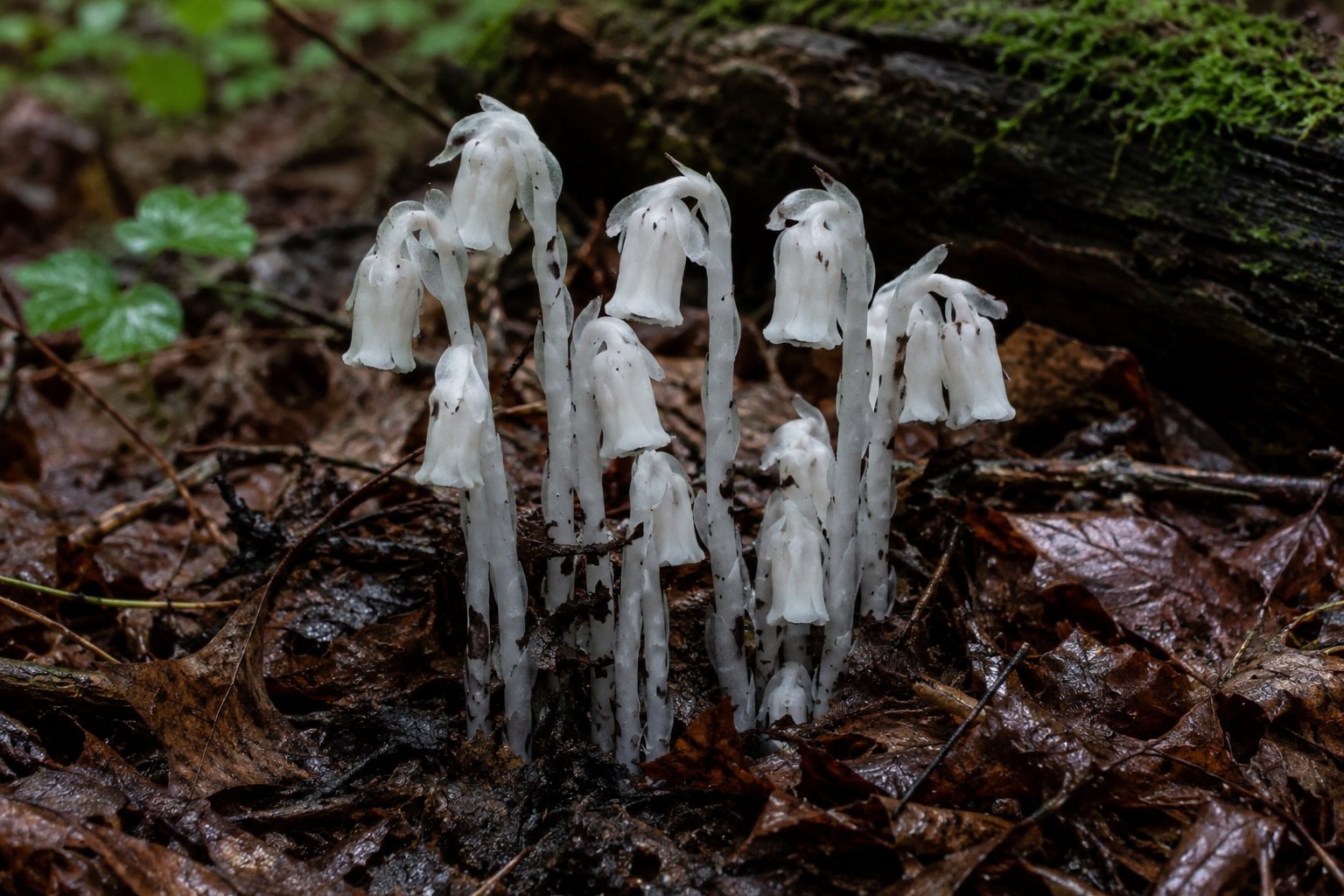
A cluster of pale ghost pipe on a dark forest floor can look like a fungus. It is a flowering plant, Monotropa uniflora, also called Indian pipe. Its lack of green color points toward a different way of obtaining food, rather than a failure to become a proper plant. Pinesap, beechdrops and dodder add other variations to that lesson.
These plants should not all be assigned the same hidden relationship. Some obtain food through fungi associated with tree roots; others connect directly to living plants. The above-ground color is a clue, but the route of nourishment is the more useful distinction.
The white plant and the green tree
The U.S. Forest Service's ghost pipe account describes a plant of deep shady woods that lacks chlorophyll. Green chlorophyll allows ordinary photosynthetic plants to use sunlight in making carbohydrates. Ghost pipe takes nutrients and carbohydrates through fungi connected to tree roots instead.
That fungal connection joins the pale flowering stem to a photosynthetic tree. The plant has not escaped dependence on food made with light; the path is indirect. A cluster under dense shade can therefore be understood by looking beyond its own leaves to the living woodland around it.
The relationship is called myco-heterotrophy: a plant obtains nourishment from fungi rather than making all of its own food through photosynthesis. Ghost pipe is a fully dependent example. Not every pale parasitic plant belongs to this category, and some other plants combine photosynthesis with food obtained through fungi.
What a fungus-root partnership means
A mycorrhiza is an association between a fungus and a plant's roots. In the familiar mutual exchange, the green plant supplies food made through photosynthesis, while fungal strands help supply water and mineral nutrients from the soil. The underground association is a meeting of distinct organisms, not an extra root made by the tree itself.
Ghost pipe draws from that connected system. It is consequently misleading to describe the plant as simply eating fallen leaves. Fungi can decompose organic material, but a non-green plant such as ghost pipe obtains nourishment through its fungal relationship. The difference keeps the plant's needs attached to particular partners.
Flowering in Illinois woods
Illinois Wildflowers' Indian pipe account records scattered Illinois sites in rich deciduous woods with abundant humus, often among maples or oaks. It describes variable flowering from late spring into fall. A single fixed week cannot stand for every occurrence.
The fleshy white stems can be pinkish. Small scales replace ordinary green leaves, and each stem ends in a nodding flower. As seeds develop, the head becomes upright and the plant darkens. Flowers and later seed capsules are stages of a flowering plant, even though a first glance may suggest a mushroom.
The need for suitable fungi and woodland conditions makes transplanting unlikely to succeed. Leave plants and their root connections in place. A close photograph of a visible cluster is enough to study color, posture and the transition from flowers to upright seed heads.
Pinesap carries a flower cluster
Pinesap is a related non-green plant, often named Monotropa hypopitys. Unlike ghost pipe, it bears a cluster of nodding flowers along the upper part of a stalk. Yellow, cream and reddish forms occur. The Illinois Wildflowers account notes its presence in Illinois and describes it as less common than Indian pipe.
Pinesap also obtains food through fungi associated with trees. Its flowering time varies with region and color form; summer and autumn appearances need not be the same form. The contrast with ghost pipe is useful in the field: a flower cluster rather than an isolated terminal flower, with color that can be quite different from white.
Beechdrops connects directly to roots
Wikipedia's beechdrops account describes Epifagus virginiana as a parasitic plant dependent on American beech roots. Brown stems carry small pale and purple flowers, with tiny scale-like leaves. It lacks chlorophyll but does not use the ghost pipe route through a fungal intermediary.
A specialized connection draws nourishment from its host's roots. The flowers appear in late summer and fall, and dried stalks can persist through winter. What looks like a dry little branch beneath a beech may therefore be evidence of an entire flowering plant and a continuing root relationship.
Dodder makes its connection above ground
Wikipedia's dodder account describes Cuscuta as thin, twining parasitic plants with very little chlorophyll. Yellow, orange or reddish stems wrap around host plants, and specialized structures enter the host's vascular tissue. Some species retain a little photosynthetic ability; others rely entirely on the host.
After a suitable connection is made, the small original soil root dies. Dodder thus makes another clear contrast with the underground links of beechdrops and ghost pipe. The morels page follows fungi in a different role, while frost flowers explains pale shapes made of ice. The natural events calendar sets these unlike appearances within the woodland year.