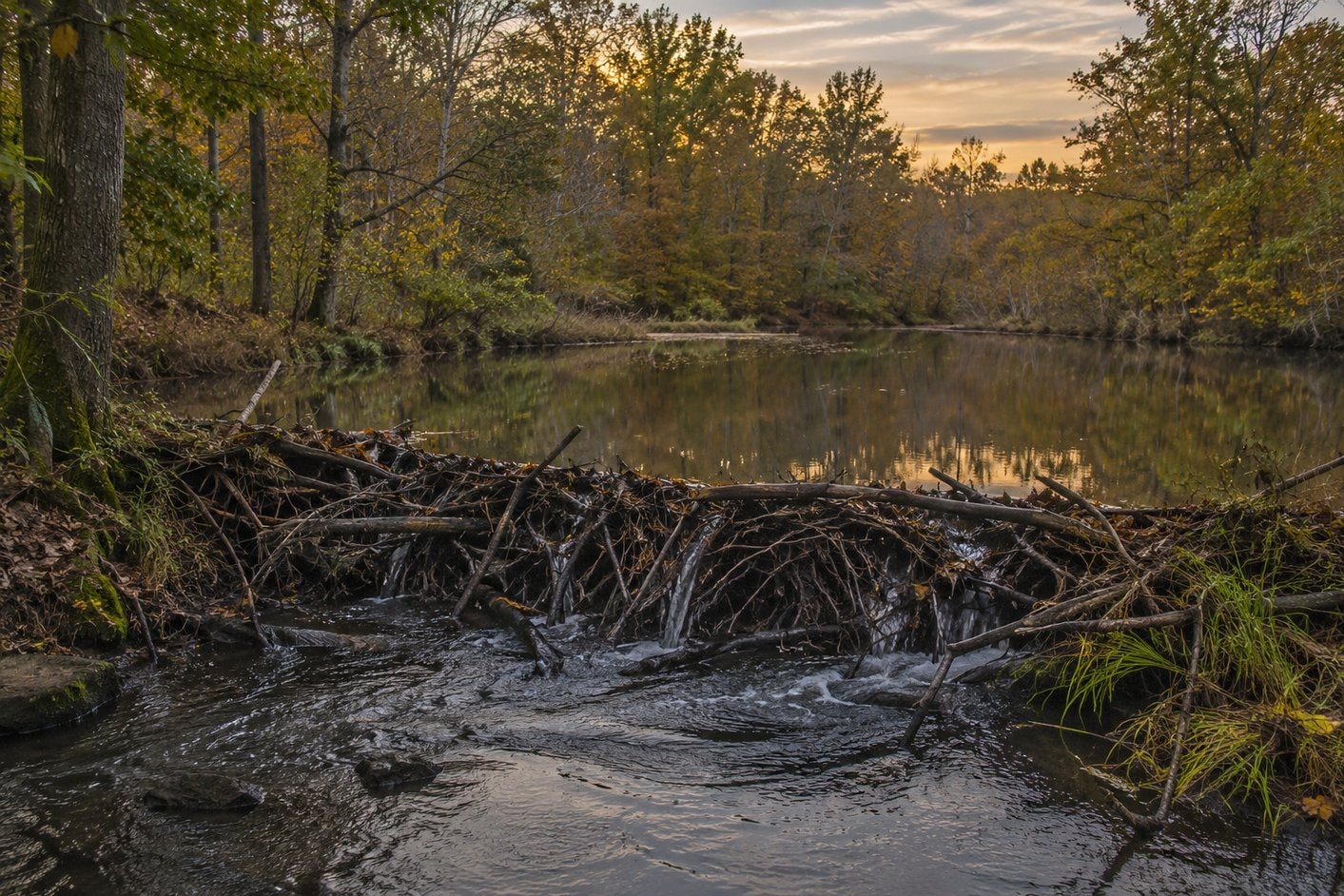
A beaver dam is a way of making deep water where the stream has not provided enough. The North American beaver, Castor canadensis, is a rodent built for a life divided between land and water. It cuts wood on shore, travels readily through water, and keeps the entrance to its shelter submerged. A dam changes the setting so that these needs can be met close together. The sticks are conspicuous; the water behind them is the point.
That distinction also explains a missing dam. Beavers can occupy a river or lake without putting a barrier across it. Where the water already serves their purposes, a bank den may be enough. A woodland creek with a dam and a broad river with gnawed trees can therefore both be beaver country, though the visible evidence differs.
Water around the front door
Wildlife Illinois explains that dams regulate water depth so the entrance to a lodge or burrow stays underwater. Most Illinois beavers live in bank burrows rather than the familiar stick lodges. The entrance is submerged, while the resting and nesting spaces inside the bank sit above the water line. A mound of sticks is consequently a poor test of whether beavers live along a particular waterway.
In a pond with suitable depth and building material, the lodge is assembled from trunks, limbs and sticks held together with mud. It may stand beside a dam or form part of it. Dam and lodge serve different tasks: the dam holds back water, and the lodge provides shelter. Calling every pile of branches a home misses that useful distinction.
The noise that sets work in motion
Wikipedia's North American beaver account describes running-water sound as a cue governing the place and timing of dam construction. A leak is therefore more than a gap to be seen. It is also water to be heard. The animal responds by placing branches and mud, maintaining the pond around its shelter rather than drawing up a human-style plan for a water project.
The materials are local and varied. Branches, rocks, grass and mud may all be used, with more rock where woody material is scarce. Strong incisors cut the trees; the front feet dig, carry and position smaller material. The dam is neither a neatly stacked fence nor an impermeable wall. Water can still move through or over it while the upstream level rises.
The construction described in the beaver-dam literature begins with changes that reduce the force of the stream. Logs and branches anchored in bottom mud form a base; smaller material fills the structure. Canals also matter. Beavers can move wood through water, extending the routes between food and shelter without carrying everything across dry ground.
A pond changes the stream
Wikipedia's account of beaver dams describes how impounded water spreads beyond the narrow channel, seeps into nearby ground and moves more slowly. The pond holds sediment and plant debris as well as water. Those changes affect the stream below the dam, the wet ground beside it, and the organisms that live in both places.
A creek that once hurried between steep banks can acquire standing-water habitat. Fish, amphibians, water birds and many other animals use the resulting wetlands. The beaver has not set out to provide for them, but its own shelter-building changes their surroundings. This is why naturalists describe the animal as an ecosystem engineer: its daily work alters the physical conditions in which other lives unfold.
The benefits are not identical everywhere. A dam can obstruct fish movement, sediment can affect spawning habitat, and pond water can have low oxygen. Flooded ground may also conflict with roads, houses or farm fields. Reading a dam means looking at the whole setting, rather than treating every pond as an automatic benefit or every felled tree as a disaster.
Food and the work of autumn
The Missouri Department of Conservation's field guide describes a seasonal shift in beaver food: leafy and other nonwoody plants are important in summer, while woody food dominates in winter. Bark and twigs are food, not merely construction supplies. Willow and cottonwood are familiar examples, but the animal uses a wider range of plants.
Beavers do not hibernate. In late summer and fall they gather branches and small trees into underwater food stores near the entrance to their shelter. Preparation can make them visible in daylight even though their usual activity is nocturnal. A trail between water and a feeding area, fresh gnawing, and stored branches all help explain what an animal is doing without requiring a close approach.
Family colonies include adults and their young. Tail slaps warn nearby beavers when danger is perceived. A slap is a reason to stop pressing closer, not an invitation to make the animal repeat the performance. Quiet observation from shore leaves the food routes and shelter undisturbed.
Living beside a changing waterway
Wildlife Illinois reports beavers as common throughout Illinois and advises tolerating colonies and dams wherever possible. Its guidance includes metal barriers around individual trees and exclusion around vulnerable drainage openings. These measures address a particular conflict while allowing the animals' wetland work to remain part of the landscape. Give wild beavers space rather than cornering or feeding them.
A pond is a chapter, not a permanent endpoint. As sediment collects or nearby food becomes scarce, beavers may leave. A neglected dam can open, the pond can drain, and vegetation can occupy the exposed wet soil. The creek, meadow and woodland need not stay in the same arrangement.
The quiet water described on the sirens page and the spring runs in the brook salamander account show how different amphibians use different wet places. The natural events calendar places the beaver's autumn preparations among the wider changes of the year.